1

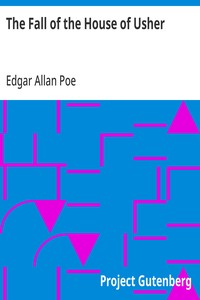
The Fall of the House of Usher — A Closer Reading
6
1
Project Gutenberg
1997
Short stories; Horror tales; Gothic fiction
Readers of public-domain and historical texts
Project Gutenberg digital edition
en
Edition facts
Words: 10,311
Reading time: 45 min
Text sections: 1
Source:
Project Gutenberg record #932
An editorial note examining Poe's precise diction and sensory description in 'The Fall of the House of Usher,' focusing on how the narrator's language conveys psychological unease through the physical environment.
Editorial Edition Score
4.3/5
★★★★★
★★★★★
Calculated from edition completeness, EPUB availability, text structure and catalogue metadata. Not a user rating.
Edition quality
From the opening sentence, Poe establishes a narrator whose perception is filtered through a lexicon of gloom: 'dull, dark, and soundless day,' 'oppressively low' clouds, 'melancholy House of Usher.' The prose itself performs the very 'insufferable' sensation it describes, refusing the reader any 'half-pleasurable' relief. The narrator's attempt to analyze his own dread—wondering whether a 'different arrangement of the particulars' might alter the effect—only deepens the mystery, as the reflection is immediately undercut by the 'shudder even more thrilling' when he gazes into the tarn. This recursive structure, where observation loops back on itself, is a key authorial choice that makes the setting feel both external and internal.
The Vocabulary of Unease
Poe's diction in the opening paragraphs is remarkably precise in its accumulation of negative modifiers. Words like 'insufferable,' 'unrelieved,' 'unredeemed,' and 'insoluble' create a semantic field of negation. The narrator compares his feeling to 'the after-dream of the reveller upon opium—the bitter lapse into every-day life—the hideous dropping off of the veil.' This simile is notable for its specificity: it does not describe the dream itself but the after-dream, the letdown. The choice of 'hideous dropping off' personifies the veil as something actively oppressive. Throughout the excerpt, Poe avoids generic horror vocabulary; instead, he selects terms that suggest a clinical, almost physiological reaction: 'iciness,' 'sinking,' 'sickening of the heart.' The effect is that the narrator's language feels both heightened and exact, as if he is trying to diagnose a condition.
The Mirror of the Tarn
A crucial structural choice is the narrator's decision to look at the house's reflection in the 'black and lurid tarn.' Rather than providing clarity, the inverted image intensifies his dread. Poe writes that the reflection shows 'the remodelled and inverted images of the gray sedge, and the ghastly tree-stems, and the vacant and eye-like windows.' The word 'remodelled' suggests an active distortion, as if the tarn itself is altering reality. The windows, already described as 'eye-like,' become even more unsettling when reflected. This doubling motif—the house and its mirror—foreshadows the later doubling between Roderick and Madeline Usher. The narrator's attempt to 'modify' his impression by changing his vantage point fails; instead, the reflection produces a 'shudder even more thrilling.' Poe thus uses the natural setting to embody the psychological principle that some fears cannot be reasoned away.
Roderick Usher's Deteriorating Voice
Poe renders Roderick Usher's decline through carefully calibrated auditory details. The narrator notes that 'the once occasional huskiness of his tone was heard no more; and a tremulous quaver, as if of extreme terror, habitually characterized his utterance.' The progression from 'occasional' to 'habitual' marks a shift from intermittent symptom to permanent condition. Later, Usher's speech becomes abrupt and charged: '“And you have not seen it?” he said abruptly, after having stared about him for some moments in silence.' The stage direction—'stared about him in silence'—creates a pause that amplifies the urgency of the question. Poe also uses the narrator's own sensory experience to convey Usher's state: the narrator hears 'a light step on an adjoining staircase' and recognizes it as Usher's, suggesting a familiarity that makes the subsequent 'mad hilarity' in Usher's eyes all the more disturbing. The voice, like the house, is a surface that betrays what lies beneath.
The Storm as Sensory Overload
The tempest scene is rendered with an almost synesthetic intensity. Poe describes 'the impetuous fury of the entering gust' that 'nearly lifted us from our feet.' The wind is not merely heard but felt as a physical force. The clouds 'hung so low as to press upon the turrets of the house,' and their 'life-like velocity' suggests a malevolent agency. The narrator emphasizes that the clouds did not 'pass away into the distance' but collided 'from all points against each other,' creating a claustrophobic, trapped quality. This is not a natural storm but a supernatural one, and Poe's language—'tempestuous yet sternly beautiful,' 'wildly singular in its terror and its beauty'—deliberately blurs the line between aesthetic appreciation and fear. The narrator's attempt to 'reason off the nervousness' fails because the storm itself seems to reason against him, its sounds and movements defying natural law.
Poe's authorial choices in 'The Fall of the House of Usher' consistently blur the boundary between the perceiver and the perceived. The narrator's language does not simply describe a haunted house; it enacts a haunting through its own recursive, self-questioning syntax. Readers attentive to the precise diction—the 'vacant eye-like windows,' the 'tremulous quaver' of Usher's voice, the 'life-like velocity' of the clouds—will find that the story's horror lies less in plot events than in the way language itself becomes a medium of contagion. The house falls, but the reader may feel that the narrator's sensibility has already collapsed.
Reader reflection
Your personal reading reflection
Build a private reading journal entry for this title.
Your progress
0
/
10
2
How much did you enjoy the reading experience?
3
Would you pass this book on to a friend?
4
How easy was the book to follow?
5
How closely did the book connect with your experience?
6
How well did it match your expectations?
7
Was the book easy to understand?
8
How useful were the ideas in this book?
9
In one sentence, what did you learn?
10