1

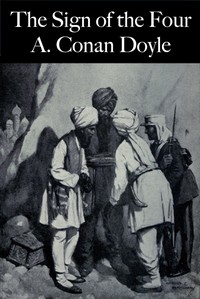
The Sign of the Four — Text and Context
8
1
Project Gutenberg
2000
Holmes, Sherlock (Fictitious character) -- Fiction; Private investigators -- England -- Fiction; Detective and mystery stories
Readers of public-domain and historical texts
Project Gutenberg digital edition
en
Edition facts
Words: 47,024
Reading time: 205 min
Text sections: 14
Source:
Project Gutenberg record #2097
In this second Sherlock Holmes novel, Arthur Conan Doyle opens with Holmes injecting cocaine, establishing his drug use as a habitual practice. The narrative follows a case involving a missing treasure, a wooden-legged man, and a steam launch called the Aurora, with Holmes deploying a network of street children as informants.
Editorial Edition Score
4.8/5
★★★★★
★★★★★
Calculated from edition completeness, EPUB availability, text structure and catalogue metadata. Not a user rating.
Edition quality
The novel begins not with a mystery but with Sherlock Holmes injecting a seven-percent cocaine solution from a morocco case, a ritual Watson has witnessed three times daily for months. Watson’s protest—that the drug risks “permanent weakness”—is met with Holmes’s claim that it is “transcendently stimulating and clarifying to the mind.” This opening establishes a pattern: the detective’s methods are inseparable from his self-destructive habits, and Watson’s role as moral counterweight is already strained.
The case that follows involves a wooden-legged man, a steam launch named Aurora, and a treasure from Agra. Holmes mobilizes the Baker Street Irregulars—a dozen ragged street-Arabs led by a boy named Wiggins—to search both banks of the river. The narrative voice alternates between Watson’s measured report and Holmes’s terse instructions, with the detective’s impatience for action contrasting with his earlier languor.
Holmes’s Drug Use as a Character Marker
The opening chapter, “The Science of Deduction,” presents Holmes’s cocaine use not as a lapse but as a deliberate choice. He injects a seven-percent solution, and Watson notes the “innumerable puncture-marks” on his forearm. Holmes defends the practice as mentally clarifying, dismissing the physical cost as “a matter of small moment.” This is not a passing reference; Watson has witnessed it for months, and his conscience swells nightly. The drug use is woven into Holmes’s character—his need for stimulation, his disregard for his own health, and his willingness to risk his “great powers” for a “mere passing pleasure.” The scene also establishes a power dynamic: Watson’s diffidence in crossing Holmes, despite his moral objections, sets the tone for their partnership.
The Baker Street Irregulars and Street-Level Investigation
When Holmes needs to locate the steam launch Aurora, he summons the Baker Street Irregulars—a group of ragged street children led by Wiggins. They arrive with “a swift pattering of naked feet” and stand in line with “expectant faces.” Holmes pays them a shilling each and promises a guinea to the boy who finds the boat. He instructs them to cover both banks of the river, reporting to Wiggins, who reports to him. This system of informal intelligence contrasts with official police methods, which Holmes dismisses as ineffective. The Irregulars are portrayed as efficient and loyal, able to “go everywhere, see everything, overhear every one.” Their presence underscores Holmes’s reliance on unconventional resources and his ability to command loyalty from the city’s margins.
The Role of the Newspaper Report in the Narrative
In a later excerpt, Holmes reads aloud a newspaper account of the crime. The report is written in a pompous, self-congratulatory style, praising the police for their “prompt and energetic action” and “single vigorous and masterful mind.” Holmes finds it “gorgeous” and grins over his coffee. The report misattributes the investigation to the police, while Holmes and Watson are actually the ones pursuing the case. This moment highlights the gap between public perception and private reality. The newspaper’s version is a fiction that Holmes enjoys for its irony. It also serves as a narrative device: the reader knows more than the public, and the tension between official accounts and actual events becomes a running theme.
The excerpts reveal a novel that balances detection with character study. Holmes’s drug use, his deployment of street children, and the ironic newspaper report all point to a story that is as much about the detective’s methods and personality as about the puzzle itself. Readers should pay attention to how Doyle uses Watson’s perspective to frame Holmes—as both admirable and troubling. The incomplete excerpts leave the treasure and the wooden-legged man unresolved, but the groundwork for their resolution is laid in these early scenes.
Reader reflection
Take a moment to reflect on this book
Create a short personal record of your experience with this book.
Your progress
0
/
10
2
Did this book hold your interest?
3
Would you encourage someone else to read it?
4
What was the reading difficulty like?
5
Which aspect of the book did you value most?
6
Did the book deliver what you hoped for?
7
Could you apply anything you learned?
8
Did you relate to its people, ideas, or situations?
9
What is the main idea you are taking away?
10