L
Lisa Mays
Guest
- Thread Author
- #1
Most fruit trees don't need a routine dose of liquid fertilizer just because the calendar says it's feeding time. A healthy tree in adequately irrigated soil may already have enough nutrients, and adding more can produce vigorous leaves and shoots while reducing fruiting. The sensible question isn't “Which bottle should I buy?” It's “What evidence shows that my tree needs fertilizer?”
Liquid fertilizer is a delivery method, not a diagnosis. Used after inspection and testing, it can place measured nutrients where roots or foliage can use them. Used blindly, it makes overfeeding easy, especially because a concentrated product can move quickly through irrigation water or across leaves.
Start with the tree, not the product label. Look at the current season's shoot growth, leaf color, fruiting pattern, irrigation, and the condition of the trunk and root zone. Poor growth may reflect a nutrient shortage, but drought, pests, root injury, compacted soil, unsuitable pH, or inconsistent watering can create similar symptoms.
Healthy backyard fruit trees in ordinary, adequately irrigated soils often need no fertilizer. Extension guidance recommends applying nutrients when a deficiency or soil test supports the decision, rather than following a fixed calendar. That recommendation matters more with liquid products because their convenience encourages repeated applications even when the tree has no confirmed need. The Leaves & Soul guide to recognizing plant nutrient needs is a useful starting point for observing symptoms before mixing a solution.
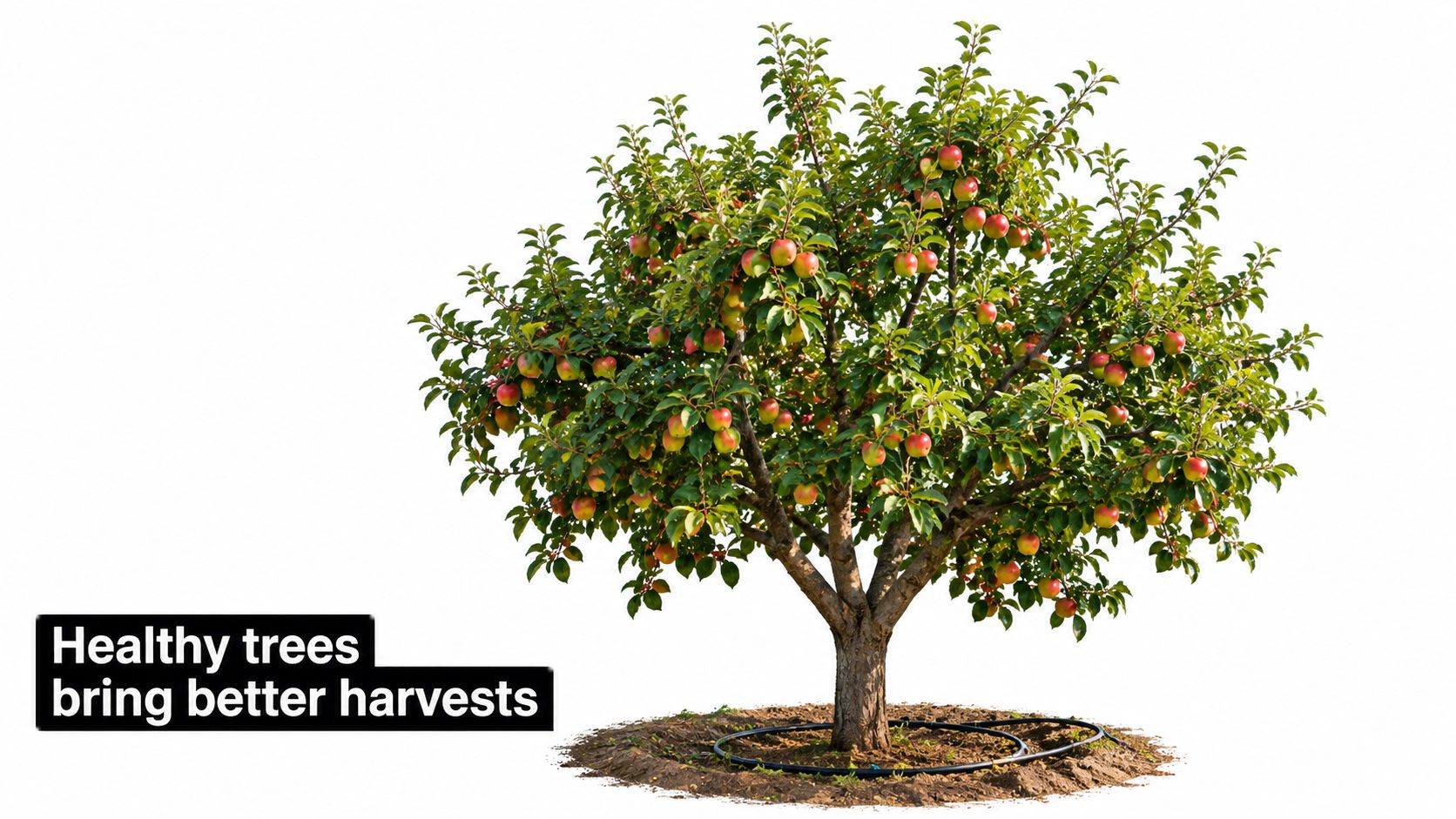
Annual shoot growth gives you a practical measure of vigor. Weak extension growth combined with pale or undersized foliage may justify closer investigation. Lush shoots, very large leaves, and poor fruiting point in the opposite direction, particularly if nitrogen has been applied repeatedly.
Leaf symptoms also need context. Yellowing can result from drought or damaged roots, not only a nitrogen or micronutrient deficiency. A tree planted in unsuitable soil may contain nutrients that its roots can't access effectively. Testing the soil, checking moisture at root depth, and inspecting for pests or trunk damage can prevent an unnecessary feeding.
A soil test is stronger evidence than a calendar reminder. Where testing isn't available, delay feeding if the tree is drought-stressed, newly disturbed, or otherwise declining for an unexplained reason. Restoring consistent moisture and correcting the underlying problem may improve growth without adding nutrients.
The best outcome may be doing nothing. A tree with healthy foliage, reasonable annual growth, and satisfactory fruiting has already given you evidence that its current nutrient supply is working.
Older orchard practice often treated fertilizer as a generalized yield input. Modern nutrient management asks a more useful question: how much does the tree require after accounting for what the soil, irrigation water, mineralization, and amendments already provide?
Washington State University expresses the framework as “Dose = Demand – Supply” in its guidance on fruit-tree nutrition. The calculation must then account for the portion of applied nitrogen that the orchard absorbs. A liquid product may dissolve and move quickly, but fast movement isn't the same as efficient uptake.
Liquid delivery can be valuable when a grower needs an even application through soil or irrigation. It can also create a concentrated stream of nutrients in the wrong place, particularly when a solution is poured beside the trunk, applied to dry soil, or delivered during weather that limits root activity.
This is why the product form should come after the nutrient decision. First identify the nutrient and the amount required. Then select a delivery method that places it in the active root zone or, where appropriate, on a specific target such as a confirmed foliar deficiency.
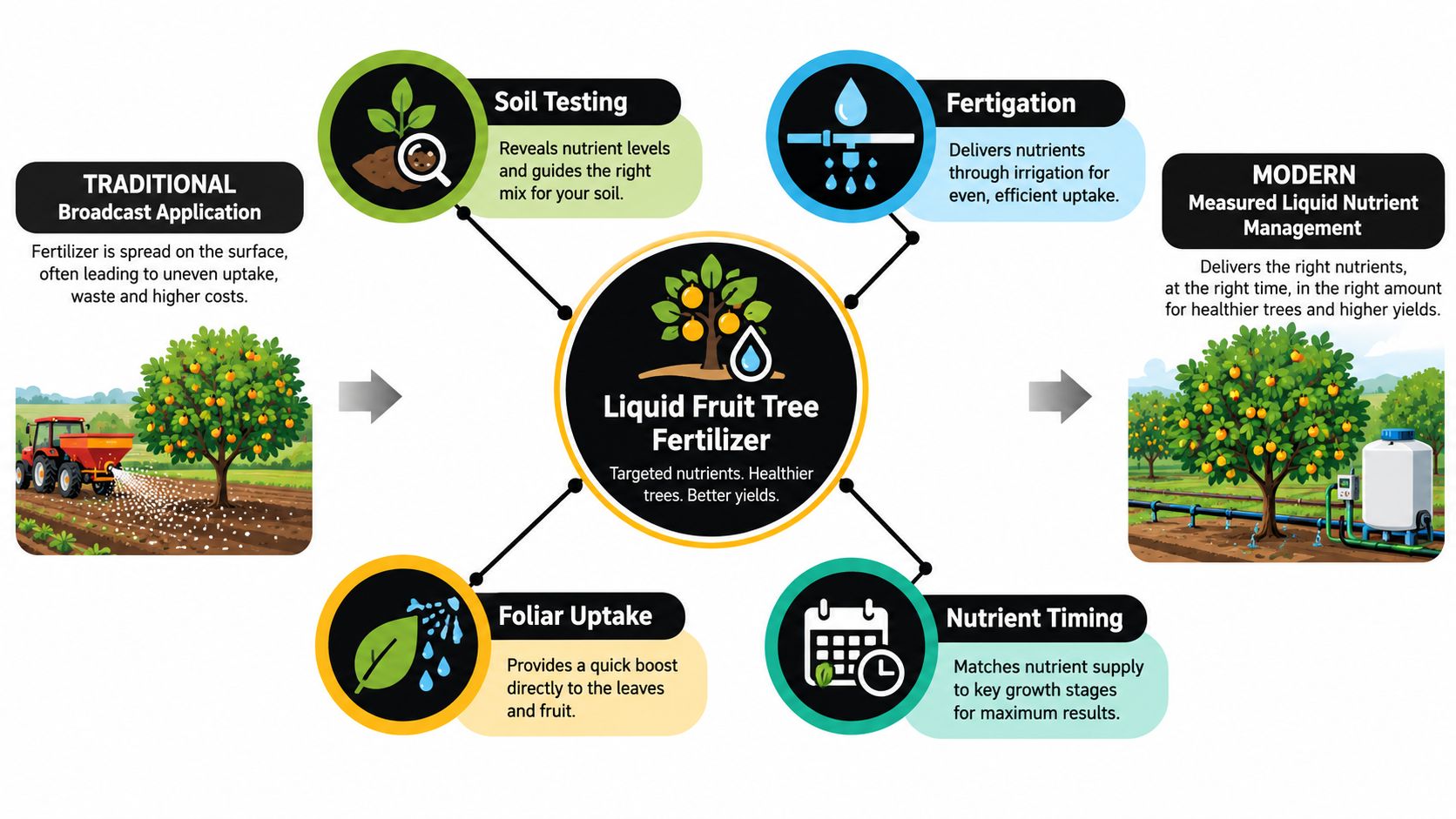
Fruit trees require nitrogen, phosphorus, potassium, magnesium, calcium, sulfur, and several micronutrients, including boron, chlorine, and copper. But supplying all of them routinely can be counterproductive if the soil already meets the tree's needs.
Research indexed through the Food and Agriculture Organization reported that spring soil-applied liquid fertilization in organic apple production produced higher nitrogen contents in soil and trees than a dried-manure treatment. That finding illustrates the potential of liquid delivery, but it doesn't turn liquid fertilizer into a universal prescription. It shows why delivery method, timing, and nutrient availability must be evaluated together.
The same measured approach makes sense at the crop level. FAO has reported that horticultural and fruit crops represented about 20% of total fertilizer use in one agricultural analysis, while their production value approached 80% of the value attributed to field crops excluding sugar cane. The practical lesson is clear: high-value fruit production rewards precision, not maximum application.
Read the guaranteed analysis before measuring the liquid. The relevant figure is the fertilizer's actual elemental nitrogen, not the total volume of product in the bottle.
For home-grown pome fruits such as apples and pears, Colorado State University Extension gives a maximum annual rate of 0.10 pound of actual nitrogen per inch of trunk diameter. For stone fruits such as peaches, cherries, plums, and nectarines, the maximum is 0.125 pound per inch. Measure trunk diameter 1 foot above ground level, and treat these as maximum annual rates, not automatic targets. The Colorado State University nitrogen guidance also emphasizes using growth and soil information when setting the final amount.
The label's percentage is a fraction for calculation. Don't confuse the product's weight or liquid volume with the nitrogen it supplies. If the label provides only volume-based directions, follow them unless you can reconcile them with the guaranteed analysis and the tree's measured requirement. For broader safety guidance around household fertilizer use, fertilizing safely around kids and pets provides useful handling context.
Young trees should receive fertilizer across a 3-to-4-foot-diameter circle, kept 8 to 10 inches away from the trunk. Mature trees are commonly fertilized across a band that roughly follows the canopy. Apply the diluted solution uniformly instead of creating one saturated patch.
A concentrated stream against bark can injure the trunk, while a heavy dose in one small area can damage roots. Placement also affects nutrient loss, so avoid runoff and don't apply to bone-dry soil. The Leaves & Soul guidance on fertilizer application rates can complement the label, but the product label and crop-specific calculation should control the final dilution.
Soil drenching, fertigation, and foliar spraying aren't interchangeable. Each method solves a different problem, and choosing the wrong one can leave the root-zone issue untouched while creating new damage on leaves or fruit.
Soil drenching is the straightforward choice when a soil-applied nutrient is required. Diluted fertilizer goes across the active root zone, where roots can absorb macronutrients such as nitrogen, phosphorus, and potassium. It works best when the soil has adequate moisture and the solution is distributed evenly.
Fertigation delivers nutrients through irrigation. It can provide uniform coverage when the irrigation system wets the root zone consistently, but an uneven system can create uneven nutrition. Check emitters, avoid applying a concentrated dose at one point, and account for nutrients already present in irrigation water or soil.
Foliar spraying has a narrower role. Extension guidance describes it as a targeted, temporary correction for confirmed micronutrient deficiencies and for directing relatively immobile nutrients such as calcium toward fruit or boron toward flower buds. It shouldn't replace root-zone fertility management.
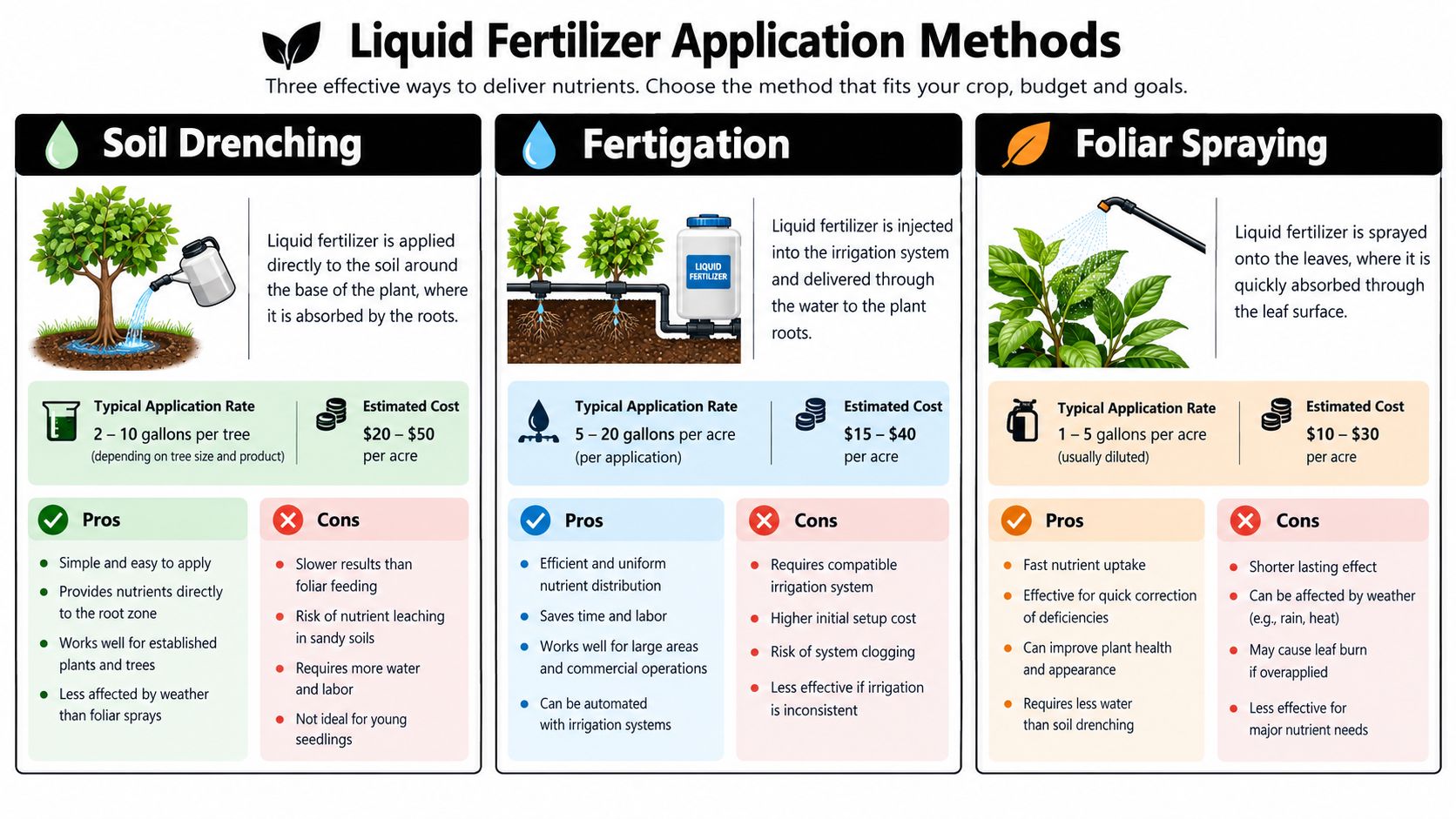
Use soil or irrigation delivery for broad macronutrient needs. Use a foliar spray only when symptoms or tissue testing identify a specific deficiency and the label supports foliar application. A temporary improvement in leaf color doesn't prove that the root-zone problem has been corrected.
Foliar solutions can burn leaves, shoots, buds, or fruit when the concentration is too high. Dilute strictly according to the label, test a small area first, and spray under cool, overcast conditions that reduce evaporation and leaf burn. Avoid hot or drought-stressed foliage.
For gardeners comparing practical application techniques, the Leaves & Soul fertilizer application methods guide offers additional context. Whatever the source, the principle remains the same: root-zone feeding supplies the foundation, while foliar feeding provides a limited, evidence-based correction.
Don't apply a foliar spray immediately before overhead irrigation, because water can remove the treatment before it has served its intended purpose. A spray also isn't a shortcut around poor soil structure, damaged roots, or an unsuitable pH.
Fruit trees don't use nutrients at the same rate throughout the season. Uptake begins after leaf-out and is highest from shoot growth through later fruit development. Applying nutrients outside those periods raises the chance of waste, runoff, or misplaced growth.
Commercial orchard guidance commonly divides nitrogen around bloom and after bloom, particularly on lighter soils. A home grower can adapt that principle by using smaller, measured applications rather than one large dose, provided the annual amount remains within the calculated requirement and the tree needs feeding.
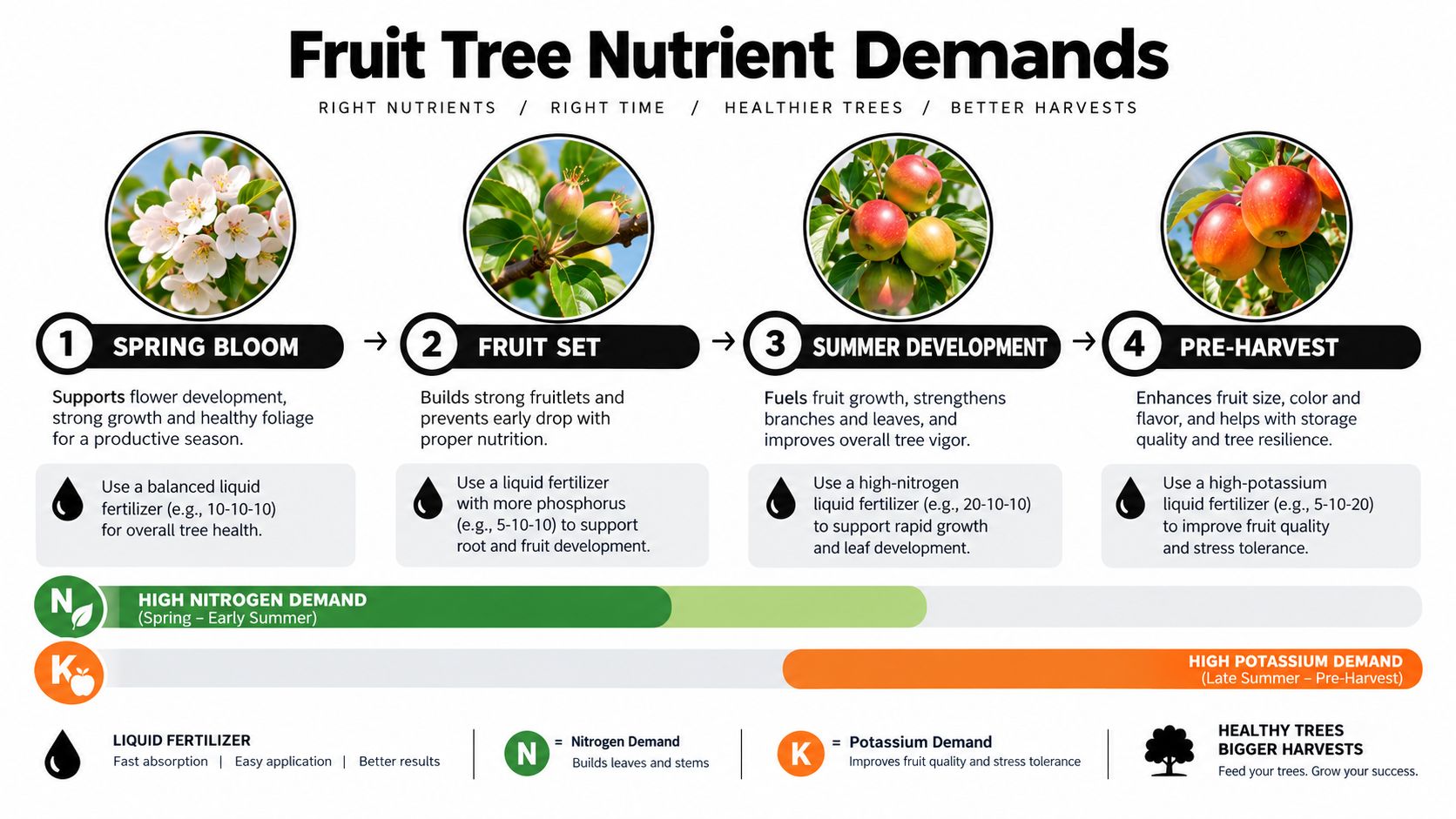
Late-season nitrogen can stimulate soft growth that hasn't hardened before winter. That new growth is more vulnerable to winter injury, and excessive vegetative growth can compete with fruit production. A schedule should therefore remain flexible. If the tree already has strong shoots and dark, vigorous foliage, withholding fertilizer may be the correct seasonal decision.
For a broader garden-planning perspective, Premier Gardens fertilizing advice can help you compare scheduling principles across plants. Fruit trees still require crop-specific judgment, especially where nitrogen rates and fruiting behavior differ.
A reliable decision tree starts with a refusal to treat symptoms as proof. Yellow leaves, weak shoots, and a disappointing harvest can result from several unrelated causes, so the first task is to separate nutrition from water, roots, pests, and soil chemistry.
Inspect the canopy and compare new growth with older foliage. Look for consistent patterns rather than one damaged leaf. Record whether shoots appear weak, whether leaves are pale or undersized, and whether the tree is producing excessive leafy growth with little fruit.
Next, check moisture in the active root zone. A drought-stressed tree shouldn't be fertilized because roots need moisture to absorb nutrients. Correct irrigation first, then observe whether the tree recovers.
Use this sequence before mixing liquid fertilizer:
This approach also protects against false reassurance from a quick visual response. A greener leaf after foliar feeding may show temporary surface uptake, but it doesn't establish that the root system, soil pH, or broader fertility is adequate. Continue monitoring and retest when the original symptom persists.
The leaves burned after spraying. The dilution may have been too strong, the foliage may have been hot or drought-stressed, or coverage may have been excessive. Stop the treatment, rinse only if the product label permits it, and don't repeat the spray until you've tested a small area under cool, overcast conditions.
The fertilizer ran onto the trunk. Wash concentrated residue from bark if the label permits, then change your technique. Apply diluted solution across the root zone, keeping young-tree applications 8 to 10 inches away from the trunk as recommended by extension guidance.
Nothing improved. Recheck the diagnosis. Foliar feeding may provide a temporary correction for a confirmed micronutrient deficiency, but it won't repair damaged roots, poor irrigation, unsuitable pH, or a missing macronutrient supply in the soil.
The tree is drought-stressed. Don't fertilize it yet. Restore consistent moisture and wait for active recovery, because dry roots can't use the application effectively.
The canopy is lush but fruiting is poor. Stop routine nitrogen applications and review the annual amount, timing, pollination conditions, pruning, and crop load. Excess nitrogen can push vegetative growth at the expense of fruiting, especially when late applications encourage soft growth.
Overhead irrigation followed the foliar spray. Water can remove the treatment before it works as intended. Check the label for the required drying or absorption conditions, and schedule future sprays when weather and irrigation allow adequate contact.
Liquid fertilizer works when it follows evidence, measured calculation, suitable placement, and active tree demand. It fails when the bottle replaces diagnosis.
Leaves & Soul offers liquid fertilizers for fruit and vegetable plants that are diluted before application, along with targeted plant nutrients and soil products for home growers. Visit Leaves & Soul to compare those options, then choose a product only after your tree's symptoms, soil, moisture, and nutrient needs point to a clear decision.
Liquid fertilizer is a delivery method, not a diagnosis. Used after inspection and testing, it can place measured nutrients where roots or foliage can use them. Used blindly, it makes overfeeding easy, especially because a concentrated product can move quickly through irrigation water or across leaves.
Does Your Tree Actually Need Fertilizer
Start with the tree, not the product label. Look at the current season's shoot growth, leaf color, fruiting pattern, irrigation, and the condition of the trunk and root zone. Poor growth may reflect a nutrient shortage, but drought, pests, root injury, compacted soil, unsuitable pH, or inconsistent watering can create similar symptoms.
Healthy backyard fruit trees in ordinary, adequately irrigated soils often need no fertilizer. Extension guidance recommends applying nutrients when a deficiency or soil test supports the decision, rather than following a fixed calendar. That recommendation matters more with liquid products because their convenience encourages repeated applications even when the tree has no confirmed need. The Leaves & Soul guide to recognizing plant nutrient needs is a useful starting point for observing symptoms before mixing a solution.
Read growth before reaching for nitrogen
Annual shoot growth gives you a practical measure of vigor. Weak extension growth combined with pale or undersized foliage may justify closer investigation. Lush shoots, very large leaves, and poor fruiting point in the opposite direction, particularly if nitrogen has been applied repeatedly.
Leaf symptoms also need context. Yellowing can result from drought or damaged roots, not only a nitrogen or micronutrient deficiency. A tree planted in unsuitable soil may contain nutrients that its roots can't access effectively. Testing the soil, checking moisture at root depth, and inspecting for pests or trunk damage can prevent an unnecessary feeding.
Practical rule: If watering, root health, and soil conditions haven't been checked, fertilizer is a guess.
A soil test is stronger evidence than a calendar reminder. Where testing isn't available, delay feeding if the tree is drought-stressed, newly disturbed, or otherwise declining for an unexplained reason. Restoring consistent moisture and correcting the underlying problem may improve growth without adding nutrients.
The best outcome may be doing nothing. A tree with healthy foliage, reasonable annual growth, and satisfactory fruiting has already given you evidence that its current nutrient supply is working.
The Shift to Measured Nutrient Management
Older orchard practice often treated fertilizer as a generalized yield input. Modern nutrient management asks a more useful question: how much does the tree require after accounting for what the soil, irrigation water, mineralization, and amendments already provide?
Washington State University expresses the framework as “Dose = Demand – Supply” in its guidance on fruit-tree nutrition. The calculation must then account for the portion of applied nitrogen that the orchard absorbs. A liquid product may dissolve and move quickly, but fast movement isn't the same as efficient uptake.
Why liquid changes the management problem
Liquid delivery can be valuable when a grower needs an even application through soil or irrigation. It can also create a concentrated stream of nutrients in the wrong place, particularly when a solution is poured beside the trunk, applied to dry soil, or delivered during weather that limits root activity.
This is why the product form should come after the nutrient decision. First identify the nutrient and the amount required. Then select a delivery method that places it in the active root zone or, where appropriate, on a specific target such as a confirmed foliar deficiency.
Quantity isn't the same as effectiveness
Fruit trees require nitrogen, phosphorus, potassium, magnesium, calcium, sulfur, and several micronutrients, including boron, chlorine, and copper. But supplying all of them routinely can be counterproductive if the soil already meets the tree's needs.
Research indexed through the Food and Agriculture Organization reported that spring soil-applied liquid fertilization in organic apple production produced higher nitrogen contents in soil and trees than a dried-manure treatment. That finding illustrates the potential of liquid delivery, but it doesn't turn liquid fertilizer into a universal prescription. It shows why delivery method, timing, and nutrient availability must be evaluated together.
The same measured approach makes sense at the crop level. FAO has reported that horticultural and fruit crops represented about 20% of total fertilizer use in one agricultural analysis, while their production value approached 80% of the value attributed to field crops excluding sugar cane. The practical lesson is clear: high-value fruit production rewards precision, not maximum application.
Calculating Nitrogen Doses and Placement
Read the guaranteed analysis before measuring the liquid. The relevant figure is the fertilizer's actual elemental nitrogen, not the total volume of product in the bottle.
For home-grown pome fruits such as apples and pears, Colorado State University Extension gives a maximum annual rate of 0.10 pound of actual nitrogen per inch of trunk diameter. For stone fruits such as peaches, cherries, plums, and nectarines, the maximum is 0.125 pound per inch. Measure trunk diameter 1 foot above ground level, and treat these as maximum annual rates, not automatic targets. The Colorado State University nitrogen guidance also emphasizes using growth and soil information when setting the final amount.
Work through the calculation
- Measure the trunk. Use a tape measure or calipers at the required height, one foot above ground level. Record the diameter in inches.
- Choose the crop category. Apples and pears use the pome-fruit rate. Peaches, cherries, plums, and nectarines use the stone-fruit rate.
- Calculate the nitrogen target. Multiply trunk diameter by the applicable maximum rate.
- Convert nitrogen into product. Divide the required nitrogen mass by the fertilizer's nitrogen fraction. A product labeled 10% nitrogen contains 0.10 pound of nitrogen per pound of product, so the product amount must be greater than the elemental nitrogen amount.
| Fruit Category | Common Examples |
|---|---|
| Pome fruits | Apple, pear |
| Stone fruits | Peach, cherry, plum, nectarine |
[th]
Max Nitrogen (lb/inch trunk)
[/th][td]
0.10
[/td][td]
0.125
[/td]The label's percentage is a fraction for calculation. Don't confuse the product's weight or liquid volume with the nitrogen it supplies. If the label provides only volume-based directions, follow them unless you can reconcile them with the guaranteed analysis and the tree's measured requirement. For broader safety guidance around household fertilizer use, fertilizing safely around kids and pets provides useful handling context.
Put the solution where feeder roots can use it
Young trees should receive fertilizer across a 3-to-4-foot-diameter circle, kept 8 to 10 inches away from the trunk. Mature trees are commonly fertilized across a band that roughly follows the canopy. Apply the diluted solution uniformly instead of creating one saturated patch.
A concentrated stream against bark can injure the trunk, while a heavy dose in one small area can damage roots. Placement also affects nutrient loss, so avoid runoff and don't apply to bone-dry soil. The Leaves & Soul guidance on fertilizer application rates can complement the label, but the product label and crop-specific calculation should control the final dilution.
Choosing the Right Application Method
Soil drenching, fertigation, and foliar spraying aren't interchangeable. Each method solves a different problem, and choosing the wrong one can leave the root-zone issue untouched while creating new damage on leaves or fruit.
Soil drenching is the straightforward choice when a soil-applied nutrient is required. Diluted fertilizer goes across the active root zone, where roots can absorb macronutrients such as nitrogen, phosphorus, and potassium. It works best when the soil has adequate moisture and the solution is distributed evenly.
Fertigation delivers nutrients through irrigation. It can provide uniform coverage when the irrigation system wets the root zone consistently, but an uneven system can create uneven nutrition. Check emitters, avoid applying a concentrated dose at one point, and account for nutrients already present in irrigation water or soil.
Foliar spraying has a narrower role. Extension guidance describes it as a targeted, temporary correction for confirmed micronutrient deficiencies and for directing relatively immobile nutrients such as calcium toward fruit or boron toward flower buds. It shouldn't replace root-zone fertility management.
Match the tool to the symptom
Use soil or irrigation delivery for broad macronutrient needs. Use a foliar spray only when symptoms or tissue testing identify a specific deficiency and the label supports foliar application. A temporary improvement in leaf color doesn't prove that the root-zone problem has been corrected.
Foliar solutions can burn leaves, shoots, buds, or fruit when the concentration is too high. Dilute strictly according to the label, test a small area first, and spray under cool, overcast conditions that reduce evaporation and leaf burn. Avoid hot or drought-stressed foliage.
For gardeners comparing practical application techniques, the Leaves & Soul fertilizer application methods guide offers additional context. Whatever the source, the principle remains the same: root-zone feeding supplies the foundation, while foliar feeding provides a limited, evidence-based correction.
Don't apply a foliar spray immediately before overhead irrigation, because water can remove the treatment before it has served its intended purpose. A spray also isn't a shortcut around poor soil structure, damaged roots, or an unsuitable pH.
Timing Applications for Fruit Set and Ripening
Fruit trees don't use nutrients at the same rate throughout the season. Uptake begins after leaf-out and is highest from shoot growth through later fruit development. Applying nutrients outside those periods raises the chance of waste, runoff, or misplaced growth.
Commercial orchard guidance commonly divides nitrogen around bloom and after bloom, particularly on lighter soils. A home grower can adapt that principle by using smaller, measured applications rather than one large dose, provided the annual amount remains within the calculated requirement and the tree needs feeding.
Use growth stages as your timing guide
- After leaf-out: Confirm that the tree is actively growing and that moisture is adequate before applying anything.
- Around bloom and fruit set: If testing and growth history support nitrogen, a split application can align availability with active demand.
- During fruit development: Monitor canopy color, shoot vigor, and fruit development instead of adding fertilizer automatically.
- Toward harvest: Avoid a late nitrogen push unless a specific, well-supported need exists.
Late-season nitrogen can stimulate soft growth that hasn't hardened before winter. That new growth is more vulnerable to winter injury, and excessive vegetative growth can compete with fruit production. A schedule should therefore remain flexible. If the tree already has strong shoots and dark, vigorous foliage, withholding fertilizer may be the correct seasonal decision.
For a broader garden-planning perspective, Premier Gardens fertilizing advice can help you compare scheduling principles across plants. Fruit trees still require crop-specific judgment, especially where nitrogen rates and fruiting behavior differ.
Building a Diagnostic Feeding Decision Tree
A reliable decision tree starts with a refusal to treat symptoms as proof. Yellow leaves, weak shoots, and a disappointing harvest can result from several unrelated causes, so the first task is to separate nutrition from water, roots, pests, and soil chemistry.
Begin with observation
Inspect the canopy and compare new growth with older foliage. Look for consistent patterns rather than one damaged leaf. Record whether shoots appear weak, whether leaves are pale or undersized, and whether the tree is producing excessive leafy growth with little fruit.
Next, check moisture in the active root zone. A drought-stressed tree shouldn't be fertilized because roots need moisture to absorb nutrients. Correct irrigation first, then observe whether the tree recovers.
Test the competing explanations
Use this sequence before mixing liquid fertilizer:
- Check water. Correct inconsistent irrigation or drought stress before evaluating nutrition.
- Inspect roots and trunk. Look for compaction, standing water, mechanical injury, girdling, or other damage.
- Assess pests and disease. Feeding won't fix leaf damage caused by insects or infection.
- Consider pH and soil structure. Nutrients may be present but unavailable in unsuitable soil.
- Test the soil where possible. Use the result to identify an actual shortage or imbalance.
- Compare growth with fruiting. Weak growth may support further investigation, while lush growth with poor fruiting argues against more nitrogen.
- Apply only if the evidence supports it. Choose the nutrient, rate, method, and timing that match the diagnosis.
The expert recommendation is sometimes “do nothing.” A tree with adequate growth, healthy foliage, and acceptable fruiting doesn't need a bottle added to its routine.
This approach also protects against false reassurance from a quick visual response. A greener leaf after foliar feeding may show temporary surface uptake, but it doesn't establish that the root system, soil pH, or broader fertility is adequate. Continue monitoring and retest when the original symptom persists.
Troubleshooting Common Liquid Fertilizer Mistakes
The leaves burned after spraying. The dilution may have been too strong, the foliage may have been hot or drought-stressed, or coverage may have been excessive. Stop the treatment, rinse only if the product label permits it, and don't repeat the spray until you've tested a small area under cool, overcast conditions.
The fertilizer ran onto the trunk. Wash concentrated residue from bark if the label permits, then change your technique. Apply diluted solution across the root zone, keeping young-tree applications 8 to 10 inches away from the trunk as recommended by extension guidance.
Nothing improved. Recheck the diagnosis. Foliar feeding may provide a temporary correction for a confirmed micronutrient deficiency, but it won't repair damaged roots, poor irrigation, unsuitable pH, or a missing macronutrient supply in the soil.
The tree is drought-stressed. Don't fertilize it yet. Restore consistent moisture and wait for active recovery, because dry roots can't use the application effectively.
The canopy is lush but fruiting is poor. Stop routine nitrogen applications and review the annual amount, timing, pollination conditions, pruning, and crop load. Excess nitrogen can push vegetative growth at the expense of fruiting, especially when late applications encourage soft growth.
Overhead irrigation followed the foliar spray. Water can remove the treatment before it works as intended. Check the label for the required drying or absorption conditions, and schedule future sprays when weather and irrigation allow adequate contact.
Liquid fertilizer works when it follows evidence, measured calculation, suitable placement, and active tree demand. It fails when the bottle replaces diagnosis.
Leaves & Soul offers liquid fertilizers for fruit and vegetable plants that are diluted before application, along with targeted plant nutrients and soil products for home growers. Visit Leaves & Soul to compare those options, then choose a product only after your tree's symptoms, soil, moisture, and nutrient needs point to a clear decision.