1

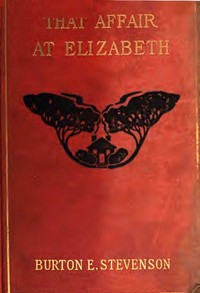
That Affair at Elizabeth — A Reader’s Guide
14
3
Project Gutenberg
2011
Fiction; Detective and mystery stories; Love stories
Readers of public-domain and historical texts
Project Gutenberg digital edition
en
Edition facts
Words: 64,792
Reading time: 282 min
Text sections: 6
Source:
Project Gutenberg record #35247
A first-person detective novel set in early 1900s New Jersey, where lawyer Lester follows a tangled case involving a missing bride, a cryptic telegram, and a midnight confrontation with a revolver-wielding woman.
Editorial Edition Score
4.7/5
★★★★★
★★★★★
Calculated from edition completeness, EPUB availability, text structure and catalogue metadata. Not a user rating.
Edition quality
The novel opens with lawyer Lester finalizing a tedious case in his office, then abruptly shifts to a personal errand: his senior partner, Mr. Royce, departs for Elizabeth to meet an old Yale friend, Burr Curtiss. The narrative quickly immerses readers in a world of legal paperwork, train schedules, and club acquaintances—details that ground the mystery in a specific professional and social milieu. The excerpts show a story told in first person, with Lester as the observing narrator, and the action soon moves to a dark house, a shadowy figure, and a revolver aimed at the protagonist. The catalog subjects label it a detective and love story, but the excerpts emphasize suspense and procedural puzzle-solving over romance.
Narrative Voice and Legal Framework
The story is narrated by Lester, a lawyer who describes himself as part of an office force “heartily tired” of a case. His tone is measured and analytical, even when recounting a late-night confrontation. The legal setting is not mere backdrop: the plot advances through depositions, telegrams, and reasoned deductions. Lester’s internal monologue—questioning whether a woman “had foreseen that we would trace it”—reveals a mind trained to weigh evidence. The excerpts contain no courtroom scenes, but the investigative method mirrors legal practice: gathering facts, testing hypotheses, and awaiting corroboration.
Setting and Atmosphere in the Excerpts
The action unfolds in two primary locations: a New York law office and the Lawrence property in Elizabeth. The office is described with specific details—pigeon-holes, papers, a clock—while the Elizabeth house is “dark and gloomy,” with a balcony and a path through a grove. The narrator makes a “careful circuit of the place” and watches from behind a tree. These details create a tangible sense of place. The time is evening, with arc lights casting a “grey background.” The atmosphere is tense but not gothic; the mystery is grounded in observable phenomena like a missing message and a locked house.
The Role of Telegrams and Misleading Clues
Communication is central to the plot. A telegram summons Lester to Elizabeth, but upon arrival he finds no message at the hotel. He speculates that a woman may have written a note on steamer paper “for the purpose of deceiving us.” The excerpts show characters interpreting and misinterpreting written messages. The narrator admits he “had really only half-believed” a sighting of the woman on a ship. This pattern of partial information and false leads is established early: the telegram is vague, the rendezvous is unstated, and the narrator must deduce where to go. The mystery thus hinges on the reliability of written and verbal clues.
Readers should attend to how the narrator’s legal training shapes his investigation: he collects statements, checks alibis, and questions motives. The excerpts offer no resolution, only a series of puzzles—a missing bride, a cryptic telegram, a woman with a revolver. The story rewards attention to small details, such as the timing of trains and the layout of the Lawrence property. The romance hinted at in the catalog subjects is not evident in these passages; the focus remains on detection and suspense.
Reader reflection
Take a moment to reflect on this book
Create a short personal record of your experience with this book.
Your progress
0
/
10
2
What was your overall reaction to the book?
3
How likely are you to recommend this book?
4
How easy was the book to follow?
5
How strong was your personal connection to the text?
6
How original did the book feel?
7
Would you read this book again?
8
How useful were the ideas in this book?
9
What changed or sharpened your thinking?
10