1

The Hand — A Reader’s Guide
11
1
Project Gutenberg
2010
Science fiction; Short stories; Human-alien encounters -- Fiction
Readers of public-domain and historical texts
Project Gutenberg digital edition
en
Edition facts
Words: 7,258
Reading time: 32 min
Text sections: 1
Source:
Project Gutenberg record #32055
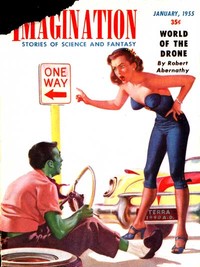
Jerry Sohl's 1955 story uses a farmwife's perspective to build tension around a dog's grisly discovery, then shifts to a stark confrontation between human cruelty and alien need. The narrative voice tightens as domestic realism gives way to science fiction.
Editorial Edition Score
4.3/5
★★★★★
★★★★★
Calculated from edition completeness, EPUB availability, text structure and catalogue metadata. Not a user rating.
Edition quality
The story opens with a deceptively ordinary scene: Alice McNearby washing breakfast dishes and watching her dog Dobie sneak toward the house. The prose moves at a domestic pace, lingering on her worry about Mac's temper and Dobie's hunting habits. When Dobie drops a human hand on the ground, the language abruptly sharpens—'her blood stopped'—and the reader is pulled into a horror that remains grounded in the farm setting. Sohl builds the first half through Alice's constrained perspective, her attempts to manage both her husband and the evidence of the dog's kill.
A Voice Constrained by Domesticity
The narrative is filtered almost entirely through Alice's consciousness, and her voice is marked by worry and self-doubt. She 'tried to put down the suspicion that gnawed at the edge of her mind' and 'found herself unable to put her heart in' scolding Dobie. The language stays close to her sensory experience—the cold ground, the milk pail used to cover the hand, the queasiness when Mac handles it. Sohl rarely steps outside her limited knowledge; even the alien is described only as 'the creature from another world somewhere.' This tight focalization makes the reader share her helplessness as events spiral beyond her control.
Pace as a Tool of Tension
The story's rhythm shifts markedly after the hand appears. Early paragraphs are leisurely, filled with backstory about Dobie's kills and Mac's threats. But once Alice sees the hand, sentences shorten: 'It was a human hand, blood still oozing from the severed wrist.' The pace accelerates through the discovery, the hiding, and the confrontation with Mac. Later, when Mac burns the hand and takes the shotgun outside, the narrative slows again, stretching time as Alice waits at the window. The final section—Alice waking at dawn to find Mac missing—returns to a quiet, almost exhausted tempo, punctuated by the discovery of the shotgun on the doorstep.
Recurring Details That Anchor the Fantastic
Sohl anchors the alien encounter in concrete, farm-specific details. The hand is not described with clinical detachment; it is 'limp, palm down,' and later wrapped in newspaper. The alien's voice is 'calm, whistling'—a small, precise detail that sets it apart from Mac's raving. The windmill light burning through the night, the shotgun on the doorstep, Dobie nuzzling Alice's hand—these recurring images tie the extraordinary to the ordinary. The story never explains the aliens' purpose or technology; the hand itself becomes the sole object of negotiation, and its destruction by fire is the irreversible act that drives the ending.
The final image—Alice following Dobie to find Mac 'in a state of sh...' (the excerpt cuts off)—leaves the resolution ambiguous. Readers should attend to how Sohl withholds information, keeping the alien's motives and Mac's fate uncertain. The story rewards attention to its small, telling gestures: a dog's nuzzle, a husband's laugh, a hand burning in the stove. These details, not grand explanations, carry the weight of the narrative.
Reader reflection
Before you leave, reflect on the book
Use these questions to collect your thoughts before moving on.
Your progress
0
/
10
2
How much did you enjoy the reading experience?
3
Would you encourage someone else to read it?
4
How much effort did this book require?
5
Did any part of the book stay with you emotionally?
6
How understandable was the text?
7
How original did the book feel?
8
Did the book deliver what you hoped for?
9
Which lesson or insight stayed with you?
10