1

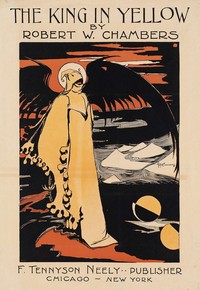
The King in Yellow — A Reader’s Guide
10
4
Project Gutenberg
2005
Short stories, American; Horror tales, American; United States -- Social life and customs -- 19th century -- Fiction
Readers of public-domain and historical texts
Project Gutenberg digital edition
en
Edition facts
Words: 76,259
Reading time: 332 min
Text sections: 8
Source:
Project Gutenberg record #8492
Chambers' collection of linked stories weaves a decadent fin-de-siècle atmosphere around the forbidden play 'The King in Yellow.' The excerpts show a shift from ornate, future-war satire to intimate Parisian studio scenes, with a cat as a silent observer and a garter bearing a name that ties to a past fate.
Editorial Edition Score
4.7/5
★★★★★
★★★★★
Calculated from edition completeness, EPUB availability, text structure and catalogue metadata. Not a user rating.
Edition quality
The opening of The King in Yellow is a study in contrasts. The first story, “The Repairer of Reputations,” begins with a long, almost bureaucratic description of a prosperous 1920s America—complete with a war with Germany over Samoa, a rebuilt Chicago, and a “superb state of defence.” The tone is measured, confident, and oddly detached. Yet this calm is undercut by the epigraph from Cassilda’s Song, which speaks of “black stars” and “Lost Carcosa.” The reader is thus primed for a world that seems stable but is secretly poisoned by a play that drives its readers mad.
From National Satire to Intimate Decay
The excerpts reveal a striking shift in setting and pace. The first story unfolds in a meticulously detailed future where “everywhere good architecture was replacing bad” and the army is organized “according to the Prussian system.” This is a public, political voice. Later, in “The Street of the Four Winds,” the narrative contracts to a single Parisian studio. The prose slows, focusing on a cat’s “noiseless tour” and the careful preparation of a meager meal: “a bit of meat, wrapped in brown paper” cut with a penknife. The cat’s reactions—flattening her ears, purring “until her voice mounted to a squeal”—become a barometer of tension. This narrowing of scope from national policy to a cat’s whiskers is a deliberate structural choice, suggesting that the true horror is personal, not geopolitical.
Objects That Carry the Weight of Story
Chambers uses small, tangible objects to anchor his narrative and hint at larger mysteries. In the first excerpt, the entire future history is built on treaties and tariffs. But in the later story, a single garter becomes the focus. The narrator unclasps it and reads the name “Sylvia Elven” engraved on the silver buckle. He then muses, “I know the little town of Elven, for there I met Fate face to face and Fate was unkind.” The garter is not just a clue; it is a relic that collapses time, connecting the present squalor of the Street of the Four Winds to a past encounter. Similarly, the cat itself is a living object of memory, recognized by the butcher and baker, and its behavior—sniffing at cracks, crouching before the door—creates a sense of watchful waiting. These details are not decorative; they are the narrative’s scaffolding.
Voice and the Unreliable Witness
The narrative voice in the excerpts is consistently first-person, but its reliability is questionable. In “The Repairer of Reputations,” the speaker presents a world of order and progress, yet the very first line—a French epigraph warning not to mock fools because “their folly lasts longer than ours”—suggests a hidden instability. The speaker’s calm recitation of military victories and architectural improvements feels like a mask. In the later story, the narrator’s voice becomes more intimate and vulnerable. He speaks to his cat, confiding his discoveries and doubts: “They tell me hard tales of your mistress which I shall not believe.” The repetition of “they say” and “I shall not believe” creates a tension between public rumor and private conviction. The reader is left to judge whether the narrator is a reliable detective or a man being slowly drawn into delusion—a question that the play at the collection’s heart only deepens.
These excerpts offer only a glimpse of Chambers’ collection, but they reveal a writer who uses shifts in scale—from the national to the domestic, from the political to the personal—to unsettle his reader. Pay attention to the objects: a garter, a cat, a bucket of water. They are never merely props. And listen to the voice: its confidence may be the first thing to crack.
Reader reflection
How will you remember this book?
Save your reaction, strongest insight, and memorable passage.
Your progress
0
/
10
2
How much did you enjoy the reading experience?
3
Is this a title you would suggest to others?
4
What was the reading difficulty like?
5
How well did it match your expectations?
6
Could you apply anything you learned?
7
How clearly were the main ideas presented?
8
How strong was your personal connection to the text?
9
Which lesson or insight stayed with you?
10