L
Lisa Mays
Guest
- Thread Author
- #1
You've watered your cactus, watched the water run into the saucer, and still found the plant looking limp a few days later. The instinct is usually to water again. Often, the problem lies underneath: a dense mix is holding moisture around the roots long after the surface appears dry.
Good cactus soil behaves more like a sieve than a sponge. It lets water pass through, leaves air-filled spaces around the roots, and dries at a predictable rate. The recipe matters, but so do particle size, pot design, planting depth, and the way you test the mix before trusting it with a living plant.
A cactus can wilt because it needs water, but it can also wilt because its roots are damaged and can no longer absorb water properly. Dense potting soil makes that second problem easy to miss. Fine organic particles settle around the roots, stay wet after irrigation, and restrict the oxygen roots need to recover between waterings.
That's why reducing watering alone doesn't always solve the issue. If the substrate remains compacted, even occasional watering can keep the lower root zone damp for too long. Root decay may begin before the stem becomes visibly soft, and by the time the damage is obvious, the plant may have lost much of its functional root system. For practical signs and treatment steps, this guide to cactus root rot treatment is a useful companion.
For a general desert cactus, begin with 1 part standard potting soil and 1 part coarse mineral material, such as perlite, pumice, or horticultural grit. This creates approximately 50% inorganic material by volume, increasing the larger air spaces that help excess water leave the root zone. This foundational cactus-soil ratio is a practical starting point, not a fixed rule for every plant and room.
Use a pot with an unobstructed drainage hole. Without one, even an excellent mix can become a reservoir for excess water. A decorative cachepot is fine, but the planted pot should be removable so you can drain it completely after watering.
The most useful quality check is tactile. Moisten a handful of the finished mix, squeeze it briefly, then open your hand.
This test measures structure more accurately than a label saying “cactus mix.” A substrate can look gritty in the bag yet become cohesive when wet. Think about what the roots experience after watering, not just how the ingredients look while dry.
A reliable mix has three jobs. The organic portion gives roots a modest moisture reserve and some nutrient-holding capacity. Mineral components create air spaces and drainage paths. Particle diversity keeps the blend from behaving like a uniform block after repeated watering.
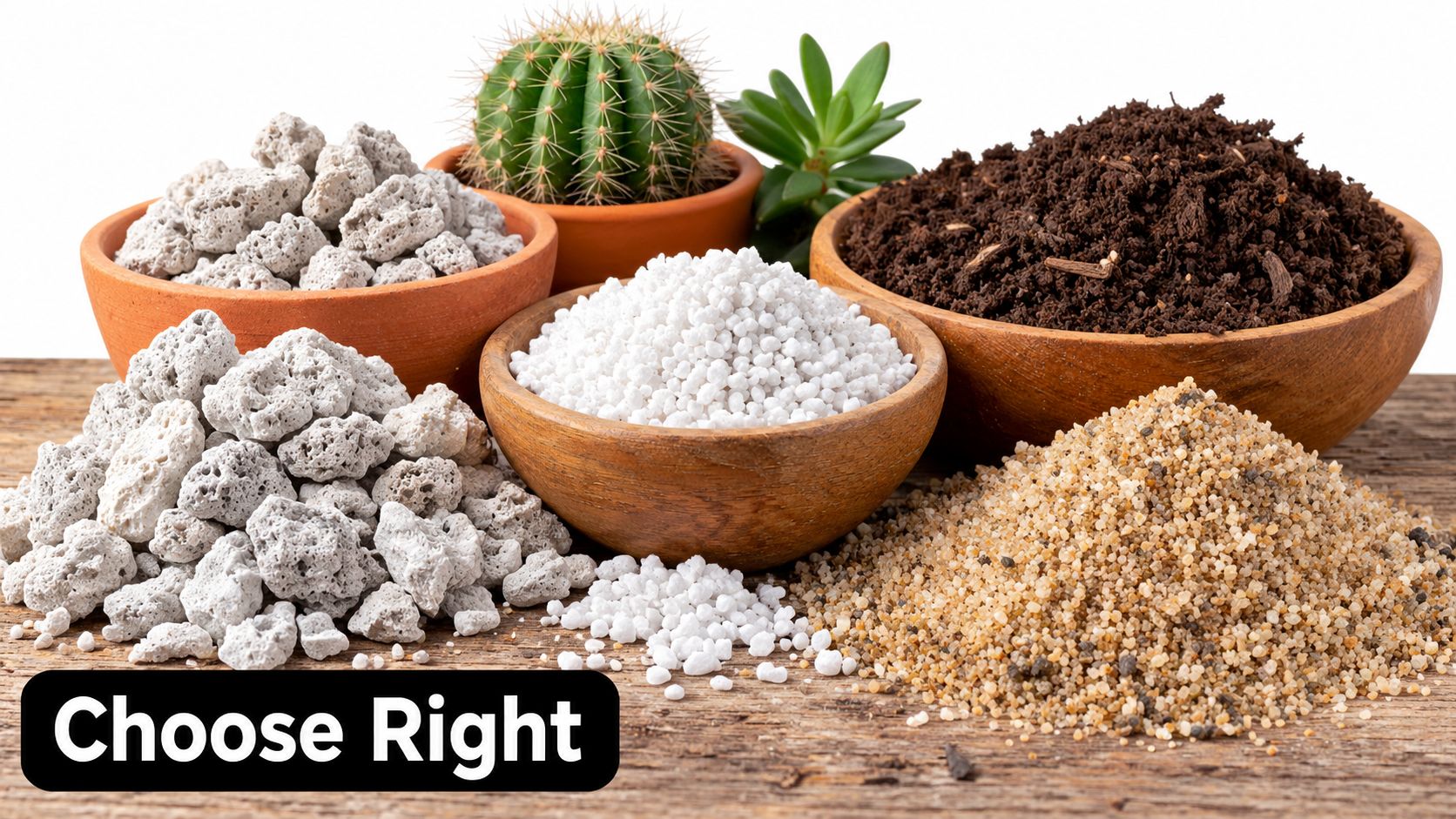
Standard potting soil supplies the organic base. Choose a reasonably open-textured mix rather than one dominated by fine compost or moisture-retaining additives. Used alone, it usually stays wet too long for a desert cactus, but diluted with coarse minerals it can provide the small moisture reserve roots still need.
Perlite is lightweight and porous, so it opens the mix without adding much container weight. It can be dusty when dry and may gradually break into smaller particles, so handle it gently and don't rely on it as the only structural ingredient.
Pumice provides durable pores and tends to remain distributed through the pot. It's particularly useful when you want long-term aeration without making the mix as light as a perlite-heavy blend.
Coarse sand, grit, or gravel adds weight and varied particle size. Look for material sold for horticultural use, with grains that remain visibly separate rather than powdery.
Fine beach, play, and masonry sand are poor substitutes. Small particles can fill the gaps between larger pieces, reducing air space and slowing drainage. By contrast, lava rock, perlite, pumice, grit, and gravel are commonly used to maintain low water retention and aeration, as explained in this guide to houseplant medium and container materials.
For broader material comparisons and practical gardening ideas, browse these home and garden articles from Prime Journal. They can help you evaluate locally available amendments without assuming every recipe needs the same imported ingredients.
A good ingredient list doesn't guarantee a good result. Inspect texture, remove large clumps, and avoid anything that becomes mudlike when wet. You can also review this breakdown of common potting mix ingredients before choosing substitutions.
The right mineral fraction depends on the plant and the room it grows in.
A balanced desert-cactus mix uses roughly equal parts potting soil and coarse mineral material. Perlite, pumice, coarse sand, or horticultural grit can work, provided the particles remain separate rather than turning dusty or compacted. This profile retains some moisture between waterings while leaving air around the roots. After wetting a sample, use the squeeze test: it should hold briefly, then crumble when released.
An ultra-draining mix suits rot-prone plants, humid climates, rooms with limited airflow, and growers whose watering schedule sometimes runs ahead of drying. Raise the mineral fraction to approximately 60–75%, with roughly 25–40% organic material. The University of Minnesota describes rapid drainage for cactus media as water passing through in less than one minute after watering. Its cacti and succulent growing guidance provides that benchmark and broader care context.
A mineral-heavy mix can create its own problems. If water disappears immediately and the material becomes dusty soon afterward, roots may receive too little usable moisture and feeding becomes harder to manage. Judge the profile by predictable drying, not by the fastest possible runoff. Particle longevity matters too. Pumice, grit, and gravel generally preserve air spaces longer than soft material that breaks down into fines.
Holiday cacti need a different profile. They are not adapted to the same dry conditions as true desert cacti. Use 1 part sterile potting soil, 2 parts peat moss, and 1 part sharp sand or perlite, following holiday-cactus potting guidance. Check the mix with a skewer after watering. If the lower portion remains wet well after the surface has dried, reduce moisture-holding material or improve the container's drainage.
Measure by volume with one consistent scoop, bucket, or measuring cup. The exact container doesn't matter. Consistency does.
Start with the dry ingredients in a clean tub. Break apart clumps of potting soil, add the mineral components, and turn the mixture repeatedly with a hand trowel. Dry blending distributes coarse particles more evenly and prevents wet organic material from forming pockets that later resist water.
The finished sample should fall apart after you squeeze and release it. If it holds a shape, add more coarse mineral material and blend again. If water runs through immediately but the mix becomes bone-dry and dusty soon afterward, you may have pushed the mineral fraction too far for your specific room.
A pH check can help when ingredients vary, especially if you've added compost, local mineral products, or unfamiliar amendments. The acceptable range for prickly pear cactus is broad, while many Opuntia plants prefer mildly acidic to neutral conditions. Use a dependable method from this guide to testing soil pH, then adjust only when there's a clear reason rather than chasing a precise number.
A good cactus mix can still fail if potting creates wet pockets. Choose a container only slightly wider than the root ball. Extra unused substrate in a large pot stays damp longer, even when the plant has used little water.
Fill the container loosely and settle the mix with a light tap. Pressing it around the roots collapses the air spaces that keep drainage and aeration balanced. Set the root crown at its original depth, with the stem above the substrate. Buried tissue remains wetter and can rot.
Water thoroughly after potting, allowing excess to leave through the drainage hole. This settles the particles around the roots and shows whether water travels through the full container. Empty the saucer after drainage stops. The pot should not sit in collected water.
A pale, dry surface does not show the condition of the lower mix. Deep containers and still rooms can leave moisture several inches down, so check below the top before watering again. This cacti and succulent watering guidance explains why surface inspection alone can mislead you.
Use the same check each time:
Water thoroughly once the lower zone has dried, then let the container drain fully. Small splashes that wet only the surface can leave deeper roots in an unpredictable moisture pattern.
Watering needs also differ by plant. True desert cacti generally tolerate a faster-drying profile, while holiday cacti prefer more moisture retention. Use the pot's drying pattern, the plant's response, and the season to adjust frequency rather than following a fixed calendar.
Cactus soil changes with use. Organic particles shrink or decompose, and poorly graded minerals can settle into dense layers. Inspect the pot after repeated watering. Slower drainage, a cohesive texture, or erratic drying signals that fresh, better-graded material may be more effective than repeated schedule changes.
Leaves & Soul offers purpose-built soils, fertilizers, and amendments for indoor and outdoor growers, including ready-to-use Professional Cactus Soil for growers who prefer a premixed starting point. Visit Leaves & Soul to compare it with plant nutrients and other growing supplies for a cactus collection.
Good cactus soil behaves more like a sieve than a sponge. It lets water pass through, leaves air-filled spaces around the roots, and dries at a predictable rate. The recipe matters, but so do particle size, pot design, planting depth, and the way you test the mix before trusting it with a living plant.
The Hidden Problem Behind Wilting Cacti
A cactus can wilt because it needs water, but it can also wilt because its roots are damaged and can no longer absorb water properly. Dense potting soil makes that second problem easy to miss. Fine organic particles settle around the roots, stay wet after irrigation, and restrict the oxygen roots need to recover between waterings.
That's why reducing watering alone doesn't always solve the issue. If the substrate remains compacted, even occasional watering can keep the lower root zone damp for too long. Root decay may begin before the stem becomes visibly soft, and by the time the damage is obvious, the plant may have lost much of its functional root system. For practical signs and treatment steps, this guide to cactus root rot treatment is a useful companion.
Start with a porous foundation
For a general desert cactus, begin with 1 part standard potting soil and 1 part coarse mineral material, such as perlite, pumice, or horticultural grit. This creates approximately 50% inorganic material by volume, increasing the larger air spaces that help excess water leave the root zone. This foundational cactus-soil ratio is a practical starting point, not a fixed rule for every plant and room.
Use a pot with an unobstructed drainage hole. Without one, even an excellent mix can become a reservoir for excess water. A decorative cachepot is fine, but the planted pot should be removable so you can drain it completely after watering.
Let the mix prove itself
The most useful quality check is tactile. Moisten a handful of the finished mix, squeeze it briefly, then open your hand.
Squeeze test: The mix should break apart when released. If it stays molded into a ball, it contains too many fine, cohesive particles and needs more coarse mineral material.
This test measures structure more accurately than a label saying “cactus mix.” A substrate can look gritty in the bag yet become cohesive when wet. Think about what the roots experience after watering, not just how the ingredients look while dry.
Choosing the Right Ingredients and Avoiding Common Pitfalls
A reliable mix has three jobs. The organic portion gives roots a modest moisture reserve and some nutrient-holding capacity. Mineral components create air spaces and drainage paths. Particle diversity keeps the blend from behaving like a uniform block after repeated watering.
What each ingredient contributes
Standard potting soil supplies the organic base. Choose a reasonably open-textured mix rather than one dominated by fine compost or moisture-retaining additives. Used alone, it usually stays wet too long for a desert cactus, but diluted with coarse minerals it can provide the small moisture reserve roots still need.
Perlite is lightweight and porous, so it opens the mix without adding much container weight. It can be dusty when dry and may gradually break into smaller particles, so handle it gently and don't rely on it as the only structural ingredient.
Pumice provides durable pores and tends to remain distributed through the pot. It's particularly useful when you want long-term aeration without making the mix as light as a perlite-heavy blend.
Coarse sand, grit, or gravel adds weight and varied particle size. Look for material sold for horticultural use, with grains that remain visibly separate rather than powdery.
Fine beach, play, and masonry sand are poor substitutes. Small particles can fill the gaps between larger pieces, reducing air space and slowing drainage. By contrast, lava rock, perlite, pumice, grit, and gravel are commonly used to maintain low water retention and aeration, as explained in this guide to houseplant medium and container materials.
For broader material comparisons and practical gardening ideas, browse these home and garden articles from Prime Journal. They can help you evaluate locally available amendments without assuming every recipe needs the same imported ingredients.
A good ingredient list doesn't guarantee a good result. Inspect texture, remove large clumps, and avoid anything that becomes mudlike when wet. You can also review this breakdown of common potting mix ingredients before choosing substitutions.
Balanced Versus Ultra-Draining Soil Profiles
The right mineral fraction depends on the plant and the room it grows in.
A balanced desert-cactus mix uses roughly equal parts potting soil and coarse mineral material. Perlite, pumice, coarse sand, or horticultural grit can work, provided the particles remain separate rather than turning dusty or compacted. This profile retains some moisture between waterings while leaving air around the roots. After wetting a sample, use the squeeze test: it should hold briefly, then crumble when released.
An ultra-draining mix suits rot-prone plants, humid climates, rooms with limited airflow, and growers whose watering schedule sometimes runs ahead of drying. Raise the mineral fraction to approximately 60–75%, with roughly 25–40% organic material. The University of Minnesota describes rapid drainage for cactus media as water passing through in less than one minute after watering. Its cacti and succulent growing guidance provides that benchmark and broader care context.
| Blend Type | Best Environment |
|---|---|
| Balanced desert mix | Bright indoor rooms with moderate airflow and ordinary desert cacti |
| Ultra-draining mix | Humid spaces, low airflow, frequent rain, or rot-prone plants |
[th]
Mineral Content
[/th][td]
About 50%
[/td][td]
Approximately 60–75%
[/td]A mineral-heavy mix can create its own problems. If water disappears immediately and the material becomes dusty soon afterward, roots may receive too little usable moisture and feeding becomes harder to manage. Judge the profile by predictable drying, not by the fastest possible runoff. Particle longevity matters too. Pumice, grit, and gravel generally preserve air spaces longer than soft material that breaks down into fines.
Holiday cacti need a different profile. They are not adapted to the same dry conditions as true desert cacti. Use 1 part sterile potting soil, 2 parts peat moss, and 1 part sharp sand or perlite, following holiday-cactus potting guidance. Check the mix with a skewer after watering. If the lower portion remains wet well after the surface has dried, reduce moisture-holding material or improve the container's drainage.
Mixing and Testing Your Custom Soil Recipe
Measure by volume with one consistent scoop, bucket, or measuring cup. The exact container doesn't matter. Consistency does.
Start with the dry ingredients in a clean tub. Break apart clumps of potting soil, add the mineral components, and turn the mixture repeatedly with a hand trowel. Dry blending distributes coarse particles more evenly and prevents wet organic material from forming pockets that later resist water.
A practical mixing sequence
- Prepare the organic base. Remove compressed chunks and inspect for material that feels sticky or sludge-like when moistened.
- Add the largest minerals first. Pumice, coarse grit, gravel, and similar pieces create the main framework of the mix.
- Distribute lighter particles. Fold in perlite carefully so it doesn't separate or float away from the heavier components.
- Moisten a sample, not the whole batch. Testing a handful keeps the remaining mix loose and makes adjustments easier.
The finished sample should fall apart after you squeeze and release it. If it holds a shape, add more coarse mineral material and blend again. If water runs through immediately but the mix becomes bone-dry and dusty soon afterward, you may have pushed the mineral fraction too far for your specific room.
A pH check can help when ingredients vary, especially if you've added compost, local mineral products, or unfamiliar amendments. The acceptable range for prickly pear cactus is broad, while many Opuntia plants prefer mildly acidic to neutral conditions. Use a dependable method from this guide to testing soil pH, then adjust only when there's a clear reason rather than chasing a precise number.
Potting Techniques and Long-Term Watering Strategy
A good cactus mix can still fail if potting creates wet pockets. Choose a container only slightly wider than the root ball. Extra unused substrate in a large pot stays damp longer, even when the plant has used little water.
Fill the container loosely and settle the mix with a light tap. Pressing it around the roots collapses the air spaces that keep drainage and aeration balanced. Set the root crown at its original depth, with the stem above the substrate. Buried tissue remains wetter and can rot.
Water thoroughly after potting, allowing excess to leave through the drainage hole. This settles the particles around the roots and shows whether water travels through the full container. Empty the saucer after drainage stops. The pot should not sit in collected water.
Test moisture below the surface
A pale, dry surface does not show the condition of the lower mix. Deep containers and still rooms can leave moisture several inches down, so check below the top before watering again. This cacti and succulent watering guidance explains why surface inspection alone can mislead you.
Use the same check each time:
- Wooden skewer: Push it several inches into the mix, leave it briefly, then inspect for dark, damp particles clinging to the wood.
- Pot weight: Lift the container after watering and again as it dries. The change becomes easier to recognize with practice.
- Multi-depth check: Test near the surface and deeper down when the readings do not agree.
Water thoroughly once the lower zone has dried, then let the container drain fully. Small splashes that wet only the surface can leave deeper roots in an unpredictable moisture pattern.
Watering needs also differ by plant. True desert cacti generally tolerate a faster-drying profile, while holiday cacti prefer more moisture retention. Use the pot's drying pattern, the plant's response, and the season to adjust frequency rather than following a fixed calendar.
Cactus soil changes with use. Organic particles shrink or decompose, and poorly graded minerals can settle into dense layers. Inspect the pot after repeated watering. Slower drainage, a cohesive texture, or erratic drying signals that fresh, better-graded material may be more effective than repeated schedule changes.
Leaves & Soul offers purpose-built soils, fertilizers, and amendments for indoor and outdoor growers, including ready-to-use Professional Cactus Soil for growers who prefer a premixed starting point. Visit Leaves & Soul to compare it with plant nutrients and other growing supplies for a cactus collection.