L
Lisa Mays
Guest
- Thread Author
- #1
You're standing in front of a shelf of orchid fertilizers, comparing labels that read 20-20-20, 30-10-10, and 10-30-20. One bottle promises greener leaves, another suggests more flowers, and the largest numbers seem tempting. The trouble is that the bold figures don't tell you how much nutrition reaches the roots.
An orchid fertilizer ratio describes the nutrient balance inside the product. Your dilution, watering frequency, orchid group, growing medium, water quality, and current growth stage determine the actual feeding program. Once you connect the label's N-P-K numbers with the amount of elemental nitrogen delivered to the pot, choosing and using fertilizer becomes much less mysterious.
Suppose two watering cans use the same 20-10-20 fertilizer. One receives a small amount of concentrate, while the other receives a much stronger mix. The label ratio remains unchanged, yet the roots encounter very different nutrient levels. That difference is the key to reading orchid fertilizer correctly.
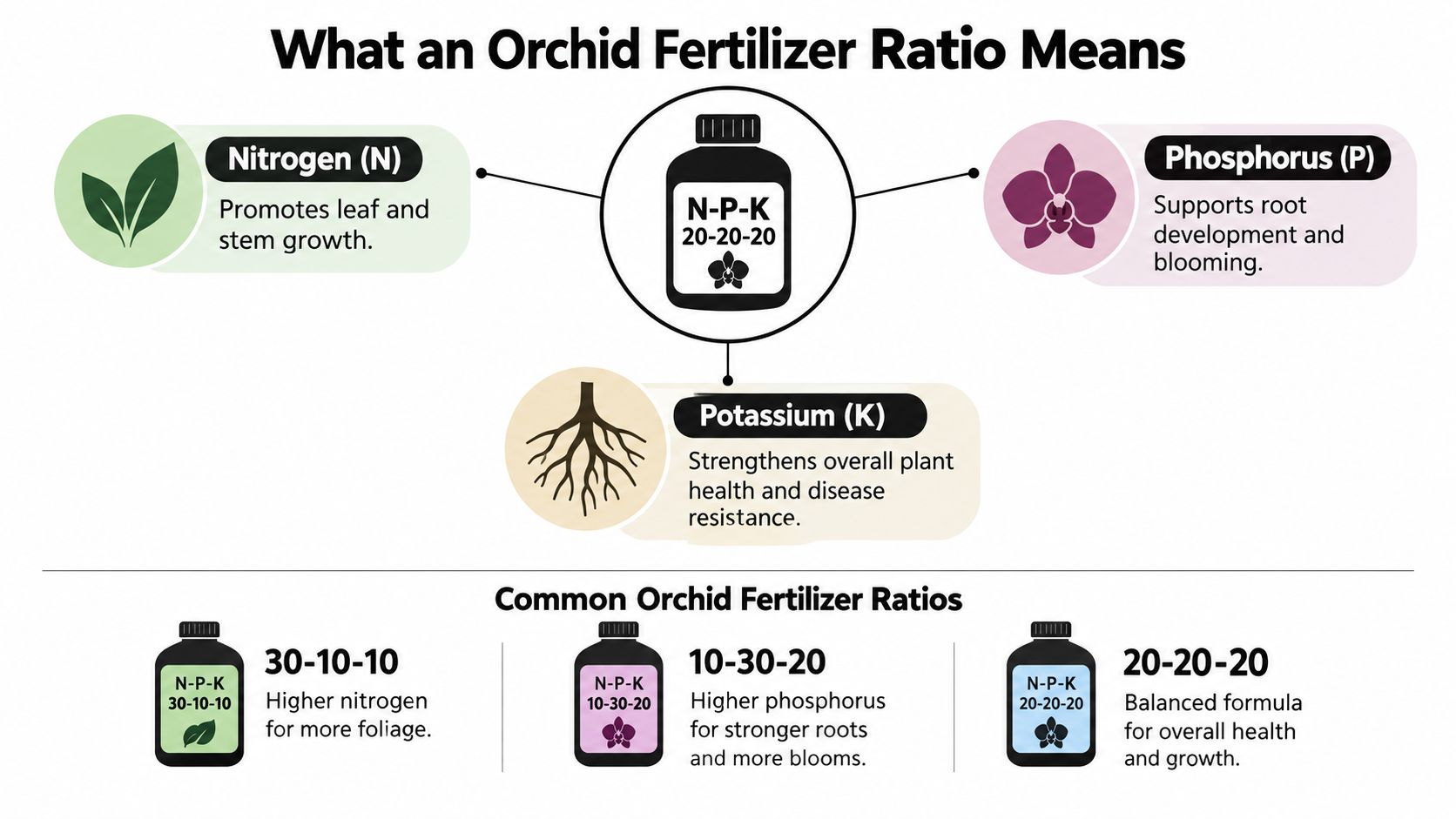
The three numbers represent nitrogen, available phosphate, and soluble potash, expressed as percentages by mass. A 20-10-20 product contains those nutrients in a 2:1:2 proportion. The ratio describes the product's balance. Your dilution and schedule determine how much reaches the roots.
Nitrogen supports leaves and other vegetative growth. Phosphorus contributes to root development and energy processes, while potassium supports general plant function and nutrient movement. A larger number for one nutrient does not automatically make a formula suitable for every orchid.
Many orchids grow in bark, moss, or another porous, low-nutrient medium instead of ordinary soil. Air moves around their roots, and concentrated fertilizer salts can remain against those roots long enough to cause injury. The American Orchid Society therefore recommends a dilute solution applied regularly, an approach often called “weakly, weekly.” Its summer guidance is approximately 1/4 to 1/2 teaspoon per U.S. gallon each week, reduced to about 1/8 to 1/4 teaspoon per gallon during winter (American Orchid Society guidance on weak orchid fertilizing).
A higher first number means more nitrogen is present in each unit of fertilizer. It does not mean you should automatically use more product. To deliver a similar nitrogen supply, a higher-nitrogen formula may require less concentrate.
For a clearer explanation of how fertilizer numbers work, consult this guide to understanding plant fertilizer numbers. Compare the nutrient proportions, then connect them to dilution, watering frequency, and the nitrogen amount your orchid can use.
Water quality belongs in the same calculation. The Oxy Plus Water lander page offers a resource for considering the water entering your growing routine. The fertilizer ratio describes what is in the bottle; water volume and dilution determine the concentration around the roots.
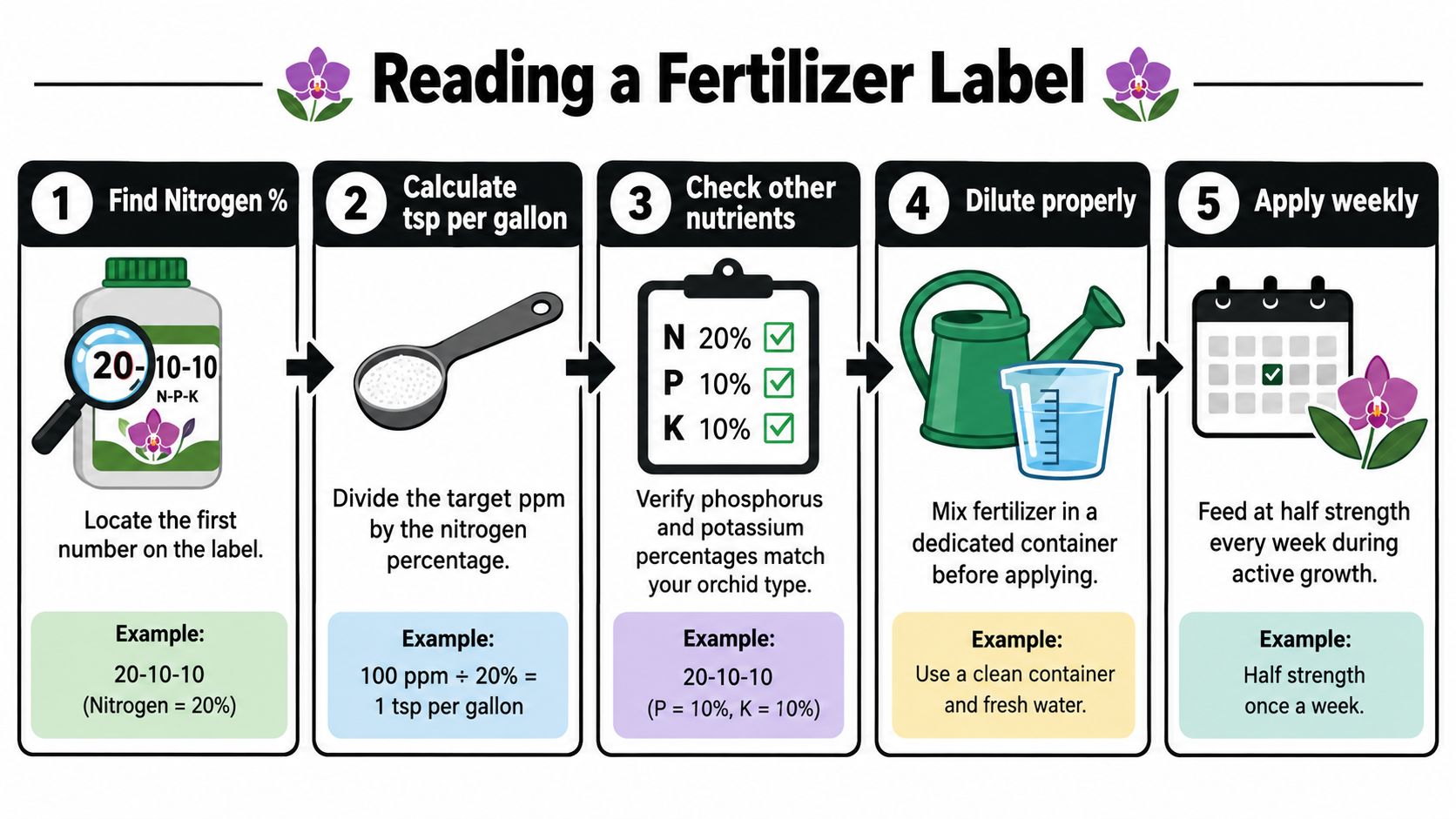
Start with the first number. It is the nitrogen percentage, and nitrogen is the most practical reference point for estimating how much fertilizer to mix. The American Orchid Society gives a calculation for a weekly solution targeting approximately 75 to 125 ppm elemental nitrogen.
For U.S. measurements, divide 8 by the fertilizer's nitrogen percentage to estimate teaspoons per U.S. gallon for a weekly application. For metric dosing, use 9.2 instead of 8 to estimate milliliters per liter. The result is a starting point. Your orchid's roots, light, water, and medium still decide how that formula performs in practice.
A 30-10-10 fertilizer makes the math easy to see. Divide 8 by 30, which gives approximately 0.27 teaspoon per gallon. In home use, that is conventionally rounded to 1/4 teaspoon per U.S. gallon. A 20-10-20 product needs a different amount because its nitrogen percentage is lower.
Turn the container around and check the nitrogen sources. Urea-based nitrogen and nitrate-based nitrogen do not behave the same way in every orchid setup. Bark and moss create a different biological environment from garden soil, so the source of nitrogen can change how predictably the plant receives nutrition.
Look for calcium, magnesium, iron, and other micronutrients in the guaranteed analysis. The headline N-P-K ratio does not show the full nutritional profile. A fertilizer can have a sensible ratio and still miss nutrients your water and medium do not supply.
If you feed every two weeks rather than weekly, the American Orchid Society calculation doubles the numerator to 16, or 18.4 for metric dosing, because each application must cover a longer interval (American Orchid Society's orchid nutrition calculation). Start conservatively if you are changing products, especially when the orchid has damaged roots or the medium holds moisture for a long time.
Commercial orchid fertilizers usually fit into three practical groups. Balanced formulas keep the headline nutrients close together. Nitrogen-forward formulas put more weight on nitrogen. Bloom formulas push more of the blend toward the phosphate side.
A fresh bark mix often makes a nitrogen-forward product a sensible starting point, while a mixed collection usually does well with one balanced fertilizer used carefully. Let the plant's growth stage and medium drive the choice rather than the boldest claim on the label.
The ratio on the front panel still does not show how much fertilizer reaches the roots after mixing. Two products can both be called balanced and still deliver different amounts of nitrogen if the dilution instructions differ.
That is why the label ratio and the actual feeding strength need to be read together. For orchid growers, the useful question is not just what numbers are printed on the bottle, but how much nitrogen the final solution delivers in the pot.
Research also cautions against assuming that more phosphorus automatically means more flowers. In Cattleya seedling studies, increased nitrogen raised flower number, while phosphorus and potassium did not affect that specific flowering measure. The practical lesson is clear. Match the formula to the plant's needs, then control the dose (orchid mineral nutrition review and species research).
A single orchid fertilizer ratio can't serve every genus equally well. Epiphytic orchids often receive small amounts of dissolved nutrients moving through bark and tree debris, while terrestrial orchids grow in richer, more soil-like conditions. Your plant's natural habit helps explain why a restrained, frequent program usually works better than occasional heavy feeding.
Phalaenopsis generally suits a balanced or moderately nitrogen-forward fertilizer during active leaf and root growth. Use a conservative dilution, especially in moss, where the medium can stay wet and hold dissolved salts around the roots.
Cattleya and related orchids often grow through a cycle of new growth, pseudobulb development, maturity, and rest. A nitrogen-forward formula can make sense while a new growth is expanding, but feeding should ease as the pseudobulb matures and the plant's activity slows.
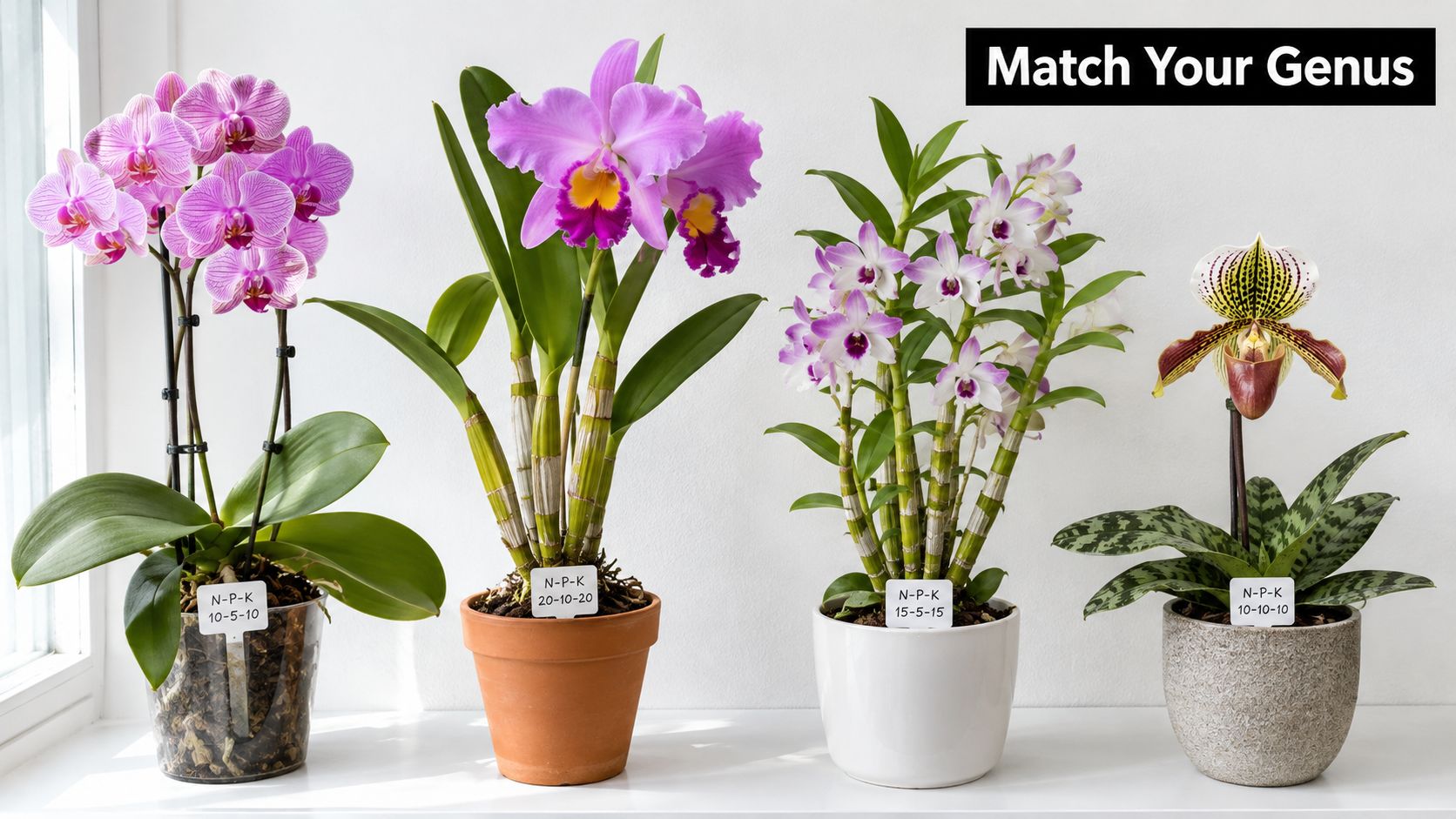
Dendrobium nutrition depends heavily on type and growth stage. Published guidance summarized in an orchid nutrition review reports approximately 100 ppm nitrogen, 25 ppm phosphorus, and 100 ppm potassium as an optimal benchmark for growth and flowering in Dendrobium nobile, but that figure belongs to a specific research context rather than every Dendrobium setup (orchid nutrition literature review).
For broader comparisons, summarized relationships sit near 1:0.4:0.8 for Cymbidium and Cattleya, and roughly 1:0.8:1.5 for Phalaenopsis. These relationships demonstrate why the best orchid fertilizer ratio is not a universal label. Use them as context, then adjust for medium, water, light, temperature, and root condition.
An orchid feeds best when it is actively pushing roots, leaves, canes, or pseudobulbs. During that growth, a dilute fertilizer ratio matches what the plant can use. If the plant is resting, its demand drops, and extra fertilizer stays behind as salts in the medium.
Active growth usually calls for a balanced formula or one with a little more nitrogen, but the strength should stay light. Weekly feeding can fit well when the potting mix dries at a steady pace between waterings. If the medium holds water for a long time, a less frequent schedule is often safer than forcing the same weekly rhythm.
Flowering does not automatically mean the orchid needs a stronger bloom mix. If roots are still active and the plant is still being watered, keep feeding light instead of increasing concentration to chase bigger flowers. A balanced feed at reduced strength is usually easier on the roots.
Season changes the plan indoors because winter light often slows growth. Reduce feeding when new root tips stop extending, new leaves slow down, and the medium remains wet longer than it did in brighter weather. In practice, winter is the time to watch the plant, not the calendar. If the orchid is not using water quickly, that is the cue to back off.
The American Orchid Society recommends reducing feed strength in winter, which makes sense because lower light usually means slower uptake (seasonal orchid fertilizing guidance).
A safe orchid fertilizer ratio still becomes harmful when the mix is too concentrated. Measure the fertilizer into a dedicated jug, add the correct amount of water, and stir or shake until the product is evenly distributed. If bark or moss is completely dry, wet it with plain water first so the fertilizer solution doesn't rush through dry channels and strike vulnerable roots.
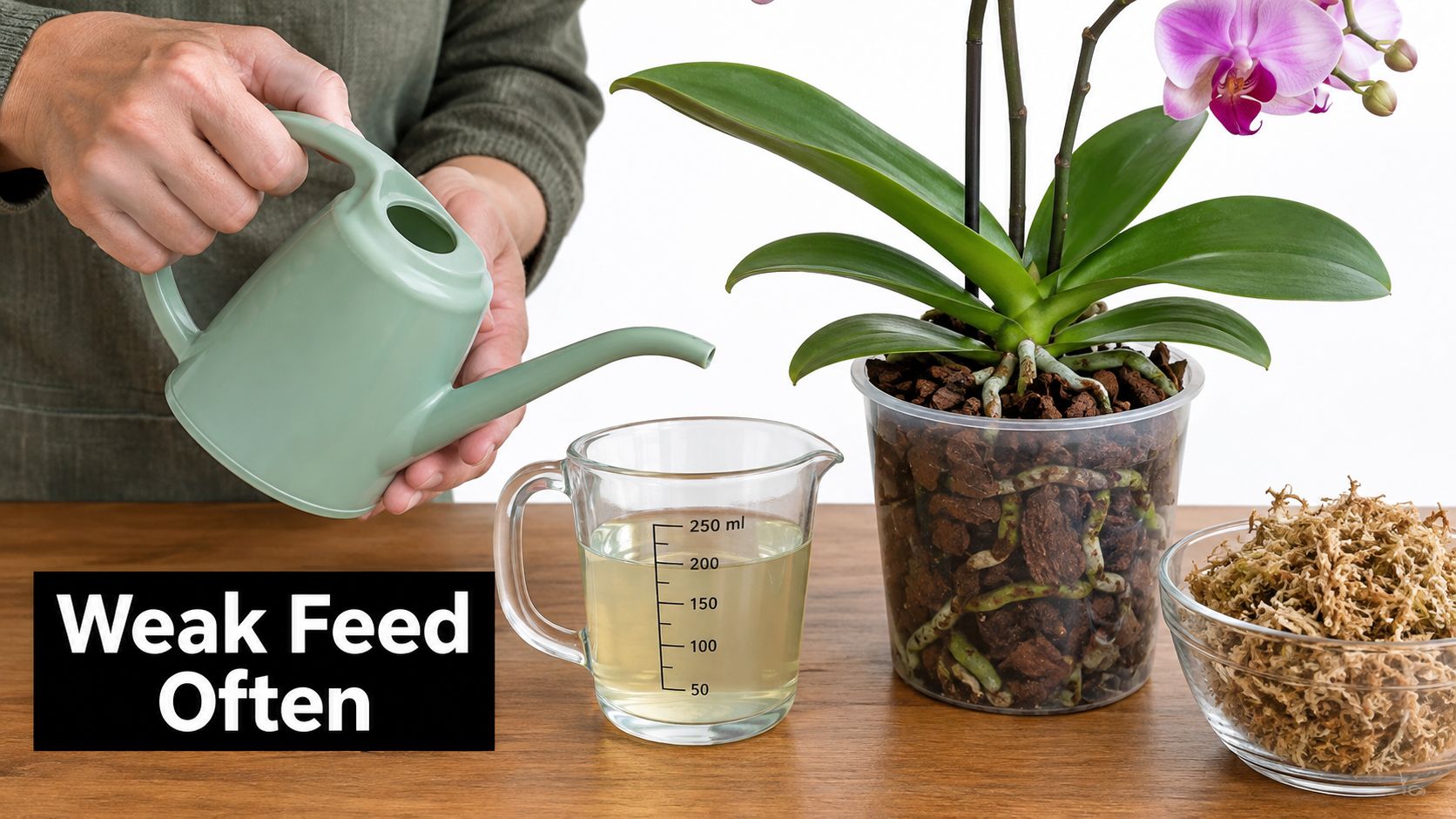
Pour the diluted solution across the root zone until it drains freely. Empty the saucer rather than allowing the pot to sit in runoff. For a Phalaenopsis in bark, the main concern is wetting the complete root mass without leaving water in the crown. For a Dendrobium in moss, use extra care because the medium can retain moisture and fertilizer longer.
Plain-water flushing removes some unused salts that accumulate between feedings. Schedule a plain-water irrigation after several fertilizer applications, and make it generous enough to pass through the pot rather than merely wetting the surface. If you see a white, crusty residue on the rim or medium, flush sooner and reduce the next fertilizer dose.
Water quality changes the starting point. If your tap water already contains substantial dissolved minerals, fertilizer adds to that overall load. A TDS meter RO guide for purifier check-ups can help you understand how growers use a meter to assess purified water systems, but a reading doesn't replace observing roots and leaves.
For more practical guidance on liquid products, see this explanation of liquid fertilizer for orchids.
Never treat liquid fertilizer and slow-release pellets as interchangeable. Liquid feeding gives you control at each watering, while slow-release products continue releasing nutrients after application. If you use a slow-release product, follow its own instructions and avoid adding a full liquid routine on top without accounting for the combined nutrient load.
Use this matrix as a starting point, not a substitute for checking roots, new growth, and how quickly the pot dries. The suggested profiles reflect broad growing patterns, while the exact product amount should come from its nitrogen percentage and your chosen schedule.
Avoid using a very high-phosphorus bloom booster as the only food for months. The research behind orchid nutrition shows that species and growth stage influence the response, and that nitrogen or potassium can be more relevant than extra phosphorus in particular situations.
If you're unsure where to begin, choose one complete fertilizer with a clearly listed nitrogen percentage and micronutrients. Calculate a conservative weekly amount, then change only one variable at a time.
A high-phosphorus bottle can look like the easy fix when an orchid refuses to flower. The label hints that more phosphate should shift the plant from leaves to blooms, but flowering depends on more than the middle number on the bag. Light, temperature, maturity, watering, and the plant's stored reserves all shape the result.
Cattleya research showed earlier that increasing nitrogen raised flower number, while phosphorus and potassium did not change that flowering measure. Zygopetalum maculatum adds a different lesson. In a controlled fertigation study, the base solution contained 100 milligrams of nitrogen per liter, 50 milligrams of phosphorus per liter, and 25 milligrams of calcium, magnesium, iron, and other micronutrient components, and adding 100 milligrams of potassium per liter weekly improved vegetative and reproductive yield while reducing potassium depletion after flowering (species-specific orchid fertigation research).
That does not make phosphorus unimportant. Orchids use it for root growth and energy transfer. It does mean that extra phosphorus is not a reliable switch for bloom production.
Healthy roots and suitable growing conditions usually matter more than changing to the most dramatic bloom label.
A bloom-leaning formula can still have a place during visible spike development, but it works as a short-term adjustment, not a fix for low light or poor temperature patterns. For a practical look at that choice, see orchid fertilizer for blooming. Keep the dose dilute, and match it to the plant's actual growth stage rather than the promise on the front of the bottle.
Orchids often show feeding problems through roots and leaves before the damage becomes severe. Look for patterns rather than reacting to one yellow leaf or one missed bloom.
When you suspect overfeeding, start with plain water. Rinse the pot thoroughly, skip fertilizer for several waterings, and then return at half of your previous strength before working back toward your target dilution. Don't compensate for damaged roots with a stronger feed. Roots must recover before the plant can use additional nutrition.
Start with the label, then connect its N-P-K ratio to the nitrogen your roots will receive. Choose a fertilizer that lists its nitrogen percentage and micronutrients clearly. Apply the earlier 8 divided by the nitrogen percentage calculation as your starting dilution, then adjust it to suit your water, orchid, and medium.
Record the product, dilution, watering date, and potting medium. Label each pot with its orchid group. A Phalaenopsis growing in bark may dry at a different pace from a Dendrobium in moss, even under the same feed. Log the first flush of new growth and photograph the roots weekly, using the images to compare progress rather than relying on one leaf.
Set a reminder for plain-water flushing after several feeds. Check whether the medium is drying as expected, and pause or reduce feeding during rest. This simple record turns a label ratio into a workable plan for the plant in front of you.
It can change the practical result because tap water may already contain dissolved minerals. The label calculation gives you a nitrogen-based starting point, but water quality, root condition, and salt deposits determine whether you should use less or flush more often.
Foliar application may supplement nutrition, but it shouldn't be treated as a complete replacement for a carefully diluted root-zone program. Leaves, roots, medium, and water all affect nutrient delivery, so keep the main routine conservative and avoid leaving solution pooled in the crown.
Yes, but change one product or schedule variable at a time. A balanced formula can serve as a baseline, while a nitrogen-forward product may suit active vegetative growth. As the earlier research shows, the ratio should follow the orchid, stage, substrate, and concentration rather than a fixed bloom-booster rule.
Only after accounting for the nutrients already being released by the pellets. Combining both formats without reducing the liquid feed can raise the total root-zone concentration beyond what the orchid can tolerate.
Leaves & Soul offers orchid-focused options alongside other plant nutrients, including slow-release orchid fertilizer pellets with a 13-11-11 N-P-K ratio. Visit Leaves & Soul to compare the available format with your orchid's group, medium, and feeding routine.
An orchid fertilizer ratio describes the nutrient balance inside the product. Your dilution, watering frequency, orchid group, growing medium, water quality, and current growth stage determine the actual feeding program. Once you connect the label's N-P-K numbers with the amount of elemental nitrogen delivered to the pot, choosing and using fertilizer becomes much less mysterious.
What an Orchid Fertilizer Ratio Actually Means
Suppose two watering cans use the same 20-10-20 fertilizer. One receives a small amount of concentrate, while the other receives a much stronger mix. The label ratio remains unchanged, yet the roots encounter very different nutrient levels. That difference is the key to reading orchid fertilizer correctly.
The three numbers represent nitrogen, available phosphate, and soluble potash, expressed as percentages by mass. A 20-10-20 product contains those nutrients in a 2:1:2 proportion. The ratio describes the product's balance. Your dilution and schedule determine how much reaches the roots.
Nitrogen supports leaves and other vegetative growth. Phosphorus contributes to root development and energy processes, while potassium supports general plant function and nutrient movement. A larger number for one nutrient does not automatically make a formula suitable for every orchid.
Why orchids need a lighter hand
Many orchids grow in bark, moss, or another porous, low-nutrient medium instead of ordinary soil. Air moves around their roots, and concentrated fertilizer salts can remain against those roots long enough to cause injury. The American Orchid Society therefore recommends a dilute solution applied regularly, an approach often called “weakly, weekly.” Its summer guidance is approximately 1/4 to 1/2 teaspoon per U.S. gallon each week, reduced to about 1/8 to 1/4 teaspoon per gallon during winter (American Orchid Society guidance on weak orchid fertilizing).
A higher first number means more nitrogen is present in each unit of fertilizer. It does not mean you should automatically use more product. To deliver a similar nitrogen supply, a higher-nitrogen formula may require less concentrate.
For a clearer explanation of how fertilizer numbers work, consult this guide to understanding plant fertilizer numbers. Compare the nutrient proportions, then connect them to dilution, watering frequency, and the nitrogen amount your orchid can use.
Water quality belongs in the same calculation. The Oxy Plus Water lander page offers a resource for considering the water entering your growing routine. The fertilizer ratio describes what is in the bottle; water volume and dilution determine the concentration around the roots.
Reading a Fertilizer Label the Right Way
Start with the first number. It is the nitrogen percentage, and nitrogen is the most practical reference point for estimating how much fertilizer to mix. The American Orchid Society gives a calculation for a weekly solution targeting approximately 75 to 125 ppm elemental nitrogen.
For U.S. measurements, divide 8 by the fertilizer's nitrogen percentage to estimate teaspoons per U.S. gallon for a weekly application. For metric dosing, use 9.2 instead of 8 to estimate milliliters per liter. The result is a starting point. Your orchid's roots, light, water, and medium still decide how that formula performs in practice.
A 30-10-10 fertilizer makes the math easy to see. Divide 8 by 30, which gives approximately 0.27 teaspoon per gallon. In home use, that is conventionally rounded to 1/4 teaspoon per U.S. gallon. A 20-10-20 product needs a different amount because its nitrogen percentage is lower.
Read beyond the front panel
Turn the container around and check the nitrogen sources. Urea-based nitrogen and nitrate-based nitrogen do not behave the same way in every orchid setup. Bark and moss create a different biological environment from garden soil, so the source of nitrogen can change how predictably the plant receives nutrition.
Look for calcium, magnesium, iron, and other micronutrients in the guaranteed analysis. The headline N-P-K ratio does not show the full nutritional profile. A fertilizer can have a sensible ratio and still miss nutrients your water and medium do not supply.
If you feed every two weeks rather than weekly, the American Orchid Society calculation doubles the numerator to 16, or 18.4 for metric dosing, because each application must cover a longer interval (American Orchid Society's orchid nutrition calculation). Start conservatively if you are changing products, especially when the orchid has damaged roots or the medium holds moisture for a long time.
Balanced, Nitrogen-Forward, and Bloom Formulas Compared
Commercial orchid fertilizers usually fit into three practical groups. Balanced formulas keep the headline nutrients close together. Nitrogen-forward formulas put more weight on nitrogen. Bloom formulas push more of the blend toward the phosphate side.
A fresh bark mix often makes a nitrogen-forward product a sensible starting point, while a mixed collection usually does well with one balanced fertilizer used carefully. Let the plant's growth stage and medium drive the choice rather than the boldest claim on the label.
| Formula Family | Best Use Case | Weekly Dilution per Gallon |
|---|---|---|
| Balanced | General maintenance for a mixed collection | Calculate from the nitrogen percentage, then dilute conservatively |
| Nitrogen-forward | Active vegetative growth, especially in low-nutrient bark | Use the nitrogen-based calculation rather than copying a full-strength label rate |
| Bloom-leaning | Optional short-term use around visible reproductive growth | Keep the solution dilute and avoid using high phosphorus as the sole long-term program |
[th]
Example N-P-K
[/th][td]
20-20-20
[/td][td]
30-10-10 or 20-10-20
[/td][td]
10-30-20 or 6-30-30
[/td]The ratio on the front panel still does not show how much fertilizer reaches the roots after mixing. Two products can both be called balanced and still deliver different amounts of nitrogen if the dilution instructions differ.
That is why the label ratio and the actual feeding strength need to be read together. For orchid growers, the useful question is not just what numbers are printed on the bottle, but how much nitrogen the final solution delivers in the pot.
Research also cautions against assuming that more phosphorus automatically means more flowers. In Cattleya seedling studies, increased nitrogen raised flower number, while phosphorus and potassium did not affect that specific flowering measure. The practical lesson is clear. Match the formula to the plant's needs, then control the dose (orchid mineral nutrition review and species research).
Matching the Ratio to Your Orchid Group
A single orchid fertilizer ratio can't serve every genus equally well. Epiphytic orchids often receive small amounts of dissolved nutrients moving through bark and tree debris, while terrestrial orchids grow in richer, more soil-like conditions. Your plant's natural habit helps explain why a restrained, frequent program usually works better than occasional heavy feeding.
Phalaenopsis and Cattleya
Phalaenopsis generally suits a balanced or moderately nitrogen-forward fertilizer during active leaf and root growth. Use a conservative dilution, especially in moss, where the medium can stay wet and hold dissolved salts around the roots.
Cattleya and related orchids often grow through a cycle of new growth, pseudobulb development, maturity, and rest. A nitrogen-forward formula can make sense while a new growth is expanding, but feeding should ease as the pseudobulb matures and the plant's activity slows.
Dendrobium and Cymbidium
Dendrobium nutrition depends heavily on type and growth stage. Published guidance summarized in an orchid nutrition review reports approximately 100 ppm nitrogen, 25 ppm phosphorus, and 100 ppm potassium as an optimal benchmark for growth and flowering in Dendrobium nobile, but that figure belongs to a specific research context rather than every Dendrobium setup (orchid nutrition literature review).
For broader comparisons, summarized relationships sit near 1:0.4:0.8 for Cymbidium and Cattleya, and roughly 1:0.8:1.5 for Phalaenopsis. These relationships demonstrate why the best orchid fertilizer ratio is not a universal label. Use them as context, then adjust for medium, water, light, temperature, and root condition.
Feeding Schedules by Growth Stage and Season
An orchid feeds best when it is actively pushing roots, leaves, canes, or pseudobulbs. During that growth, a dilute fertilizer ratio matches what the plant can use. If the plant is resting, its demand drops, and extra fertilizer stays behind as salts in the medium.
Active growth usually calls for a balanced formula or one with a little more nitrogen, but the strength should stay light. Weekly feeding can fit well when the potting mix dries at a steady pace between waterings. If the medium holds water for a long time, a less frequent schedule is often safer than forcing the same weekly rhythm.
Flowering does not automatically mean the orchid needs a stronger bloom mix. If roots are still active and the plant is still being watered, keep feeding light instead of increasing concentration to chase bigger flowers. A balanced feed at reduced strength is usually easier on the roots.
Season changes the plan indoors because winter light often slows growth. Reduce feeding when new root tips stop extending, new leaves slow down, and the medium remains wet longer than it did in brighter weather. In practice, winter is the time to watch the plant, not the calendar. If the orchid is not using water quickly, that is the cue to back off.
The American Orchid Society recommends reducing feed strength in winter, which makes sense because lower light usually means slower uptake (seasonal orchid fertilizing guidance).
Seasonal check: If root growth has paused and the pot is staying wet, lower either the concentration or the frequency. Keep the schedule aligned with the plant's pace, not the season label.
Dilution, Watering, and Salt Management
A safe orchid fertilizer ratio still becomes harmful when the mix is too concentrated. Measure the fertilizer into a dedicated jug, add the correct amount of water, and stir or shake until the product is evenly distributed. If bark or moss is completely dry, wet it with plain water first so the fertilizer solution doesn't rush through dry channels and strike vulnerable roots.
Pour the diluted solution across the root zone until it drains freely. Empty the saucer rather than allowing the pot to sit in runoff. For a Phalaenopsis in bark, the main concern is wetting the complete root mass without leaving water in the crown. For a Dendrobium in moss, use extra care because the medium can retain moisture and fertilizer longer.
Flush the medium deliberately
Plain-water flushing removes some unused salts that accumulate between feedings. Schedule a plain-water irrigation after several fertilizer applications, and make it generous enough to pass through the pot rather than merely wetting the surface. If you see a white, crusty residue on the rim or medium, flush sooner and reduce the next fertilizer dose.
Water quality changes the starting point. If your tap water already contains substantial dissolved minerals, fertilizer adds to that overall load. A TDS meter RO guide for purifier check-ups can help you understand how growers use a meter to assess purified water systems, but a reading doesn't replace observing roots and leaves.
For more practical guidance on liquid products, see this explanation of liquid fertilizer for orchids.
Never treat liquid fertilizer and slow-release pellets as interchangeable. Liquid feeding gives you control at each watering, while slow-release products continue releasing nutrients after application. If you use a slow-release product, follow its own instructions and avoid adding a full liquid routine on top without accounting for the combined nutrient load.
Quick Reference Ratios at a Glance
Use this matrix as a starting point, not a substitute for checking roots, new growth, and how quickly the pot dries. The suggested profiles reflect broad growing patterns, while the exact product amount should come from its nitrogen percentage and your chosen schedule.
| Orchid Group | Suggested N-P-K | Common Substrate | Feeding Frequency | Notes |
|---|---|---|---|---|
| Phalaenopsis | Balanced or moderately nitrogen-forward | Bark or moss | Weekly during active growth, less often in winter | Keep feeding light while flowering if growth continues |
| Cattleya | Balanced or nitrogen-forward during new growth | Bark or coarse mix | Weekly during active growth, reduced during rest | Ease off after the pseudobulb matures |
| Dendrobium | Balanced during active growth, adjusted by type | Bark or moss | Weekly while growing, reduced during rest | Nobile types may need a genuine rest |
| Cymbidium | Balanced with attention to potassium | Bark-based or moisture-retentive mix | Regular light feeding during growth, reduced when slow | Avoid treating a general formula as a universal prescription |
Avoid using a very high-phosphorus bloom booster as the only food for months. The research behind orchid nutrition shows that species and growth stage influence the response, and that nitrogen or potassium can be more relevant than extra phosphorus in particular situations.
If you're unsure where to begin, choose one complete fertilizer with a clearly listed nitrogen percentage and micronutrients. Calculate a conservative weekly amount, then change only one variable at a time.
Rethinking the Bloom Booster Myth
A high-phosphorus bottle can look like the easy fix when an orchid refuses to flower. The label hints that more phosphate should shift the plant from leaves to blooms, but flowering depends on more than the middle number on the bag. Light, temperature, maturity, watering, and the plant's stored reserves all shape the result.
Cattleya research showed earlier that increasing nitrogen raised flower number, while phosphorus and potassium did not change that flowering measure. Zygopetalum maculatum adds a different lesson. In a controlled fertigation study, the base solution contained 100 milligrams of nitrogen per liter, 50 milligrams of phosphorus per liter, and 25 milligrams of calcium, magnesium, iron, and other micronutrient components, and adding 100 milligrams of potassium per liter weekly improved vegetative and reproductive yield while reducing potassium depletion after flowering (species-specific orchid fertigation research).
That does not make phosphorus unimportant. Orchids use it for root growth and energy transfer. It does mean that extra phosphorus is not a reliable switch for bloom production.
Healthy roots and suitable growing conditions usually matter more than changing to the most dramatic bloom label.
A bloom-leaning formula can still have a place during visible spike development, but it works as a short-term adjustment, not a fix for low light or poor temperature patterns. For a practical look at that choice, see orchid fertilizer for blooming. Keep the dose dilute, and match it to the plant's actual growth stage rather than the promise on the front of the bottle.
Troubleshooting Common Feeding Problems
Orchids often show feeding problems through roots and leaves before the damage becomes severe. Look for patterns rather than reacting to one yellow leaf or one missed bloom.
- Yellowing older leaves: Nitrogen deficiency can contribute to yellowing and weak growth, but root loss, overwatering, and natural leaf aging can look similar. Check the roots before increasing fertilizer.
- Dark or damaged root tips: Concentrated salts, fertilizer applied to dry roots, or prolonged wetness may be involved. Flush with plain water and inspect the medium.
- White crust on the pot: This commonly indicates soluble-salt accumulation. Flush thoroughly and reduce the next application.
- Lush leaves without flowers: More phosphorus may not solve the problem. Review light, temperature, maturity, and whether the orchid needs a rest.
- Shriveled pseudobulbs: The plant may be under-watered, have damaged roots, or be in a rest phase. Fertilizer won't correct a root or watering problem by itself.
When you suspect overfeeding, start with plain water. Rinse the pot thoroughly, skip fertilizer for several waterings, and then return at half of your previous strength before working back toward your target dilution. Don't compensate for damaged roots with a stronger feed. Roots must recover before the plant can use additional nutrition.
Putting It All Together for This Week
Start with the label, then connect its N-P-K ratio to the nitrogen your roots will receive. Choose a fertilizer that lists its nitrogen percentage and micronutrients clearly. Apply the earlier 8 divided by the nitrogen percentage calculation as your starting dilution, then adjust it to suit your water, orchid, and medium.
Record the product, dilution, watering date, and potting medium. Label each pot with its orchid group. A Phalaenopsis growing in bark may dry at a different pace from a Dendrobium in moss, even under the same feed. Log the first flush of new growth and photograph the roots weekly, using the images to compare progress rather than relying on one leaf.
Set a reminder for plain-water flushing after several feeds. Check whether the medium is drying as expected, and pause or reduce feeding during rest. This simple record turns a label ratio into a workable plan for the plant in front of you.
Orchid Fertilizer Questions Home Growers Ask
Does tap water change the fertilizer calculation?
It can change the practical result because tap water may already contain dissolved minerals. The label calculation gives you a nitrogen-based starting point, but water quality, root condition, and salt deposits determine whether you should use less or flush more often.
Can foliar feeding replace root feeding?
Foliar application may supplement nutrition, but it shouldn't be treated as a complete replacement for a carefully diluted root-zone program. Leaves, roots, medium, and water all affect nutrient delivery, so keep the main routine conservative and avoid leaving solution pooled in the crown.
Can I switch ratios during the season?
Yes, but change one product or schedule variable at a time. A balanced formula can serve as a baseline, while a nitrogen-forward product may suit active vegetative growth. As the earlier research shows, the ratio should follow the orchid, stage, substrate, and concentration rather than a fixed bloom-booster rule.
Should I use slow-release pellets with liquid fertilizer?
Only after accounting for the nutrients already being released by the pellets. Combining both formats without reducing the liquid feed can raise the total root-zone concentration beyond what the orchid can tolerate.
Leaves & Soul offers orchid-focused options alongside other plant nutrients, including slow-release orchid fertilizer pellets with a 13-11-11 N-P-K ratio. Visit Leaves & Soul to compare the available format with your orchid's group, medium, and feeding routine.