T
TheGardenMaster
Guest
- Thread Author
- #1
Last updated: October 4, 2026
One fence board curls outward while the boards beside it still sit against the rails. Before driving another fastener through the lifted edge, check whether enough intact wood remains to hold it. A dependable repair needs both a sound board attachment area and a sound rail behind it.
First, look across the board’s width. Has the wood formed a shallow curve, or is a relatively straight board separating at one attachment? A curved board may still have secure fasteners. A straight board may have lost its hold because a nail withdrew, its head pulled through the wood, or the receiving rail deteriorated.
These problems can occur together. Follow the separation from the board’s shape to its fastening points and then into the rail. The visible gap alone cannot tell you whether to secure the board, leave a stable cup alone, or replace damaged wood.
Compare the affected board with its neighbors at the same rail. A dished profile across its width identifies cupping; a flat face lifting away at one attachment points more directly toward a connection problem.
On a vertical fence picket, look across the face from one long edge to the other. The board can remain reasonably straight from top to bottom while its edges curl away from the rail. A lengthwise bow or a twisted corner is a different shape and should not automatically be called cupping.
Boards from the same fence can respond differently because their grain orientation differs. Wood changes dimension unevenly as its moisture content changes. Curved growth rings visible at an accessible board end can help explain why one piece cups more readily than another.
Treat the grain as supporting evidence. It does not prove which face dried first, establish that the board was installed backward, or predict every movement under outdoor exposure. Knots and irregular grain can also complicate the shape.
The useful distinction is whether the curvature leaves the attachment intact. A slight cup with firmly held fastening points may be mostly an appearance issue. A lifted edge accompanied by tearing around a fastener shows that movement is affecting the connection.
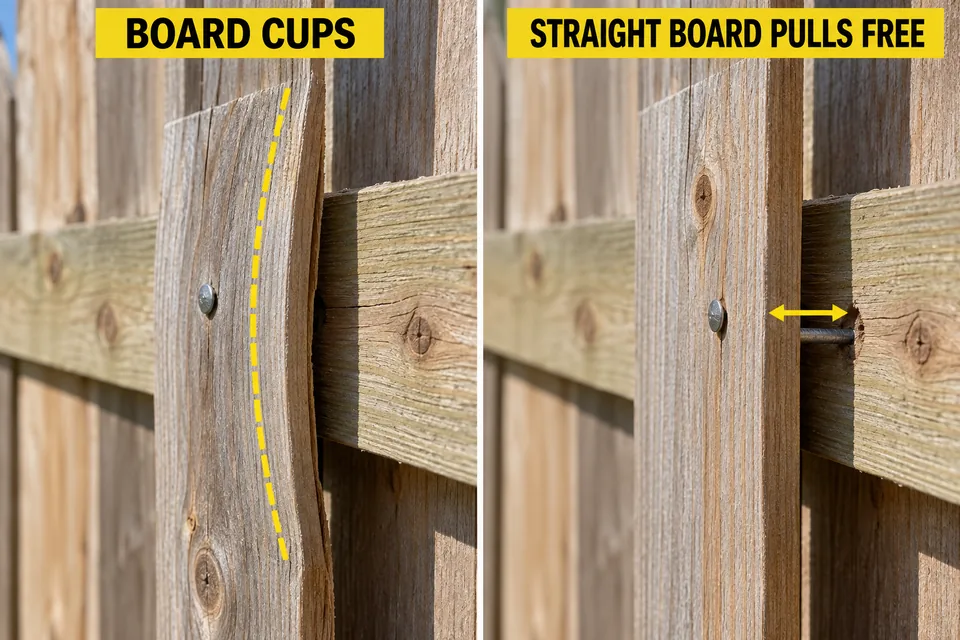
Use the location of the affected boards to test the exposure explanation. Several cupped boards on one sunny stretch give you a different clue from one loose board among otherwise flat neighbors.
Does one face receive afternoon sun while the opposite face stays shaded? Are the lower portions repeatedly wetted while the upper portions dry? Sun can accelerate drying of the exposed face, while the sheltered back responds differently. That uneven moisture change can contribute to distortion, but sun direction alone does not explain a failed fastening point.
Repeated wetting deserves equal attention. A board receiving regular irrigation can experience a different moisture cycle from one only a few feet away. If the same section gets soaked during watering, investigate persistent sprinkler overspray before treating each lifted board as an isolated defect.
Check the back where it is accessible, especially around rail contact areas and vegetation pressing against the fence. A face that looks dry from the yard does not establish that the sheltered surface has dried equally.
Similar distortion across several similarly exposed boards supports a shared moisture explanation. One flat board loose at one damaged hole directs attention toward that attachment. Use the pattern to decide where to inspect next; it cannot replace inspection of the wood and fasteners.
Inspect where the board meets each rail, including attachments that still appear secure. If only one fastening point has opened, compare its hole and surrounding wood with the intact points above or below it.
A raised nail head alone does not settle the diagnosis. The nail may have withdrawn from the rail, the board may have moved, or both may have happened. Look at the wood immediately beneath the head: intact fibers provide bearing, while a torn opening or crushed area reduces the head’s ability to hold the board.
With withdrawal, the fastener loses its hold in the rail. The board may remain relatively straight as that attachment opens. With pull-through, the fastener can remain embedded in the rail while the board moves past its head, leaving a torn opening.
A split running from a board end through a fastening point creates another weak area. Compare it with fine surface checking elsewhere: the repair-relevant issue is whether the split interrupts the wood that must hold the fastener. A long crack reaching an attachment deserves more attention than shallow weathering lines away from it.
Then check whether the rail itself stays stationary. If several boards and their rail move together, the apparent board separation may involve a rail connection that moves in the wind. Adding fasteners to individual boards will not restore that connection.
Also inspect the rail directly behind the affected attachment. Soft, crumbly, or visibly split wood cannot provide dependable purchase merely because the board in front remains solid. This is the point where an apparent single-board repair can become a support repair.
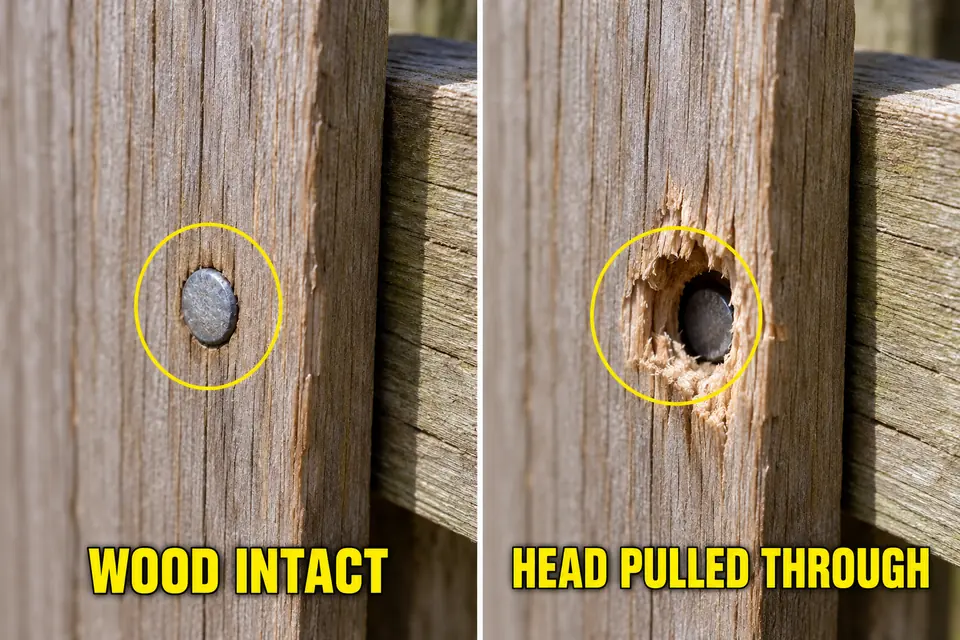
Judge the remaining attachment area before trying to close the gap. A mildly moved board may still be serviceable when its wood is firm, its ends are intact, and the receiving rail can hold a suitable fastener.
Where there are no exposed sharp fasteners or loose splinters, gentle hand pressure can help you judge the resistance. A small gap that closes easily differs from a rigid cup requiring substantial force. Easy movement does not prove the board is sound, however; torn or deteriorated wood may also move easily. Read that response alongside the attachment damage.
Do not use the fastener as a clamp to flatten severe distortion. Pulling hard against a cupped board can deepen an end split, crush the face under the head, or transfer strain into another attachment.
Likewise, driving the same nail back through a pulled-through hole does not recreate the missing wood. Securing the board requires sound material around a suitable attachment. Where a split consumes the available fastening area, replacement becomes more sensible than repeatedly fastening nearby.
A mildly cupped board that remains firmly attached may be left in place and monitored. Replacement is more appropriate when persistent distortion prevents dependable attachment or the fastening areas are badly torn, split, or deteriorated. If the rail is unsound, address that support first; a new board cannot compensate for it.
Look for new failures at the same rail or along the same exposure pattern. Those locations tell you more about continued damage than the appearance of one already-cupped board.
Additional heads pulling through, fresh splits reaching fastening points, or neighboring boards beginning to separate warrant another inspection. Damage concentrated along one rail points toward a shared support problem. Similar curling across a repeatedly wetted stretch points toward a recurring exposure condition. Neither pattern means the entire fence needs replacement.
A board that opens again after being secured is especially informative. Persistent distortion, damaged fastening wood, poor purchase in the rail, or continued deterioration remains unresolved. Repeating the same fastening attempt can enlarge the damage without changing the cause.
Keep a stable, securely held cup under observation. Secure modest movement only where both pieces of wood can support the attachment. When the same location fails again, reassess the board and rail before adding another fastener—and correct repeated wetting before it undermines the next repair.
<p>The post Wood Fence Boards That Curl Away From the Rails first appeared on The Garden Scene.</p>
One fence board curls outward while the boards beside it still sit against the rails. Before driving another fastener through the lifted edge, check whether enough intact wood remains to hold it. A dependable repair needs both a sound board attachment area and a sound rail behind it.
First, look across the board’s width. Has the wood formed a shallow curve, or is a relatively straight board separating at one attachment? A curved board may still have secure fasteners. A straight board may have lost its hold because a nail withdrew, its head pulled through the wood, or the receiving rail deteriorated.
These problems can occur together. Follow the separation from the board’s shape to its fastening points and then into the rail. The visible gap alone cannot tell you whether to secure the board, leave a stable cup alone, or replace damaged wood.
Why Some Boards Cup While Others Stay Flat
Compare the affected board with its neighbors at the same rail. A dished profile across its width identifies cupping; a flat face lifting away at one attachment points more directly toward a connection problem.
On a vertical fence picket, look across the face from one long edge to the other. The board can remain reasonably straight from top to bottom while its edges curl away from the rail. A lengthwise bow or a twisted corner is a different shape and should not automatically be called cupping.
What the grain can tell you
Boards from the same fence can respond differently because their grain orientation differs. Wood changes dimension unevenly as its moisture content changes. Curved growth rings visible at an accessible board end can help explain why one piece cups more readily than another.
Treat the grain as supporting evidence. It does not prove which face dried first, establish that the board was installed backward, or predict every movement under outdoor exposure. Knots and irregular grain can also complicate the shape.
The useful distinction is whether the curvature leaves the attachment intact. A slight cup with firmly held fastening points may be mostly an appearance issue. A lifted edge accompanied by tearing around a fastener shows that movement is affecting the connection.
Sun Exposure and Uneven Drying
Use the location of the affected boards to test the exposure explanation. Several cupped boards on one sunny stretch give you a different clue from one loose board among otherwise flat neighbors.
Does one face receive afternoon sun while the opposite face stays shaded? Are the lower portions repeatedly wetted while the upper portions dry? Sun can accelerate drying of the exposed face, while the sheltered back responds differently. That uneven moisture change can contribute to distortion, but sun direction alone does not explain a failed fastening point.
Repeated wetting deserves equal attention. A board receiving regular irrigation can experience a different moisture cycle from one only a few feet away. If the same section gets soaked during watering, investigate persistent sprinkler overspray before treating each lifted board as an isolated defect.
Check the back where it is accessible, especially around rail contact areas and vegetation pressing against the fence. A face that looks dry from the yard does not establish that the sheltered surface has dried equally.
Similar distortion across several similarly exposed boards supports a shared moisture explanation. One flat board loose at one damaged hole directs attention toward that attachment. Use the pattern to decide where to inspect next; it cannot replace inspection of the wood and fasteners.
Fastener Failure vs Board Distortion
Inspect where the board meets each rail, including attachments that still appear secure. If only one fastening point has opened, compare its hole and surrounding wood with the intact points above or below it.
A raised nail head alone does not settle the diagnosis. The nail may have withdrawn from the rail, the board may have moved, or both may have happened. Look at the wood immediately beneath the head: intact fibers provide bearing, while a torn opening or crushed area reduces the head’s ability to hold the board.
Withdrawal, pull-through, and split ends
With withdrawal, the fastener loses its hold in the rail. The board may remain relatively straight as that attachment opens. With pull-through, the fastener can remain embedded in the rail while the board moves past its head, leaving a torn opening.
A split running from a board end through a fastening point creates another weak area. Compare it with fine surface checking elsewhere: the repair-relevant issue is whether the split interrupts the wood that must hold the fastener. A long crack reaching an attachment deserves more attention than shallow weathering lines away from it.
Then check whether the rail itself stays stationary. If several boards and their rail move together, the apparent board separation may involve a rail connection that moves in the wind. Adding fasteners to individual boards will not restore that connection.
Also inspect the rail directly behind the affected attachment. Soft, crumbly, or visibly split wood cannot provide dependable purchase merely because the board in front remains solid. This is the point where an apparent single-board repair can become a support repair.
When a Warped Board Can Still Be Secured
Judge the remaining attachment area before trying to close the gap. A mildly moved board may still be serviceable when its wood is firm, its ends are intact, and the receiving rail can hold a suitable fastener.
Where there are no exposed sharp fasteners or loose splinters, gentle hand pressure can help you judge the resistance. A small gap that closes easily differs from a rigid cup requiring substantial force. Easy movement does not prove the board is sound, however; torn or deteriorated wood may also move easily. Read that response alongside the attachment damage.
Do not use the fastener as a clamp to flatten severe distortion. Pulling hard against a cupped board can deepen an end split, crush the face under the head, or transfer strain into another attachment.
Likewise, driving the same nail back through a pulled-through hole does not recreate the missing wood. Securing the board requires sound material around a suitable attachment. Where a split consumes the available fastening area, replacement becomes more sensible than repeatedly fastening nearby.
A mildly cupped board that remains firmly attached may be left in place and monitored. Replacement is more appropriate when persistent distortion prevents dependable attachment or the fastening areas are badly torn, split, or deteriorated. If the rail is unsound, address that support first; a new board cannot compensate for it.
Signs the Damage Will Continue Spreading
Look for new failures at the same rail or along the same exposure pattern. Those locations tell you more about continued damage than the appearance of one already-cupped board.
Additional heads pulling through, fresh splits reaching fastening points, or neighboring boards beginning to separate warrant another inspection. Damage concentrated along one rail points toward a shared support problem. Similar curling across a repeatedly wetted stretch points toward a recurring exposure condition. Neither pattern means the entire fence needs replacement.
A board that opens again after being secured is especially informative. Persistent distortion, damaged fastening wood, poor purchase in the rail, or continued deterioration remains unresolved. Repeating the same fastening attempt can enlarge the damage without changing the cause.
Keep a stable, securely held cup under observation. Secure modest movement only where both pieces of wood can support the attachment. When the same location fails again, reassess the board and rail before adding another fastener—and correct repeated wetting before it undermines the next repair.
<p>The post Wood Fence Boards That Curl Away From the Rails first appeared on The Garden Scene.</p>