1

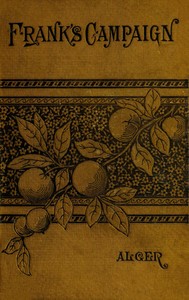
Frank's Campaign; Or, The Farm and the Camp — Context and Discussion
12
4
Project Gutenberg
1998
Conduct of life -- Juvenile fiction; Farm life -- Juvenile fiction; United States -- History -- Civil War, 1861-1865 -- Juvenile fiction
Readers of public-domain and historical texts
Project Gutenberg digital edition
en
Edition facts
Words: 65,006
Reading time: 283 min
Text sections: 9
Source:
Project Gutenberg record #1573
In Horatio Alger's 1862 novel, a war meeting in Rossville sets the stage for a story that intertwines farm life, a boy's campaign to manage the homestead, and a tall tale about a man who grows to giant size after wishing to see over a crowd.
Editorial Edition Score
4.7/5
★★★★★
★★★★★
Calculated from edition completeness, EPUB availability, text structure and catalogue metadata. Not a user rating.
Edition quality
The opening chapter of Frank's Campaign; Or, The Farm and the Camp places readers in Rossville's Town Hall on a September afternoon in 1862, where a war meeting has been called to raise the town's quota of twenty-five men. The narrator describes the hall as generally open only for town business or occasional lectures, and notes that the scattered agricultural population relies on such chance events for intellectual nutriment. This setting immediately establishes the dual focus suggested by the title: the local farm community and the distant camp of the Civil War.
Yet the excerpts also reveal a surprising tonal shift. Alongside the earnest war-meeting scene, the text includes a lengthy, absurdist tale about a man named Tubbs who wishes to be ten feet tall and instantly grows, then cannot convince his wife of his identity. This comic interlude, complete with a crushed chair and a ravenous appetite, suggests that the novel may blend patriotic duty with homespun humor and moral lessons, rather than adhering strictly to battlefield drama.
War Meeting and Rural Setting
The novel opens with a detailed depiction of a war meeting in Rossville, a town where houses “stand at respectable distances, each encamped on a farm of its own.” The placard calling citizens to decide on raising the town’s quota of twenty-five men under the President’s call is posted on barns, fences, and inside the village store and post office. This concrete detail ties the national conflict directly to local agricultural life. The narrator’s observation that Rossville is “not large enough to sustain a course of lyceum lectures” and that townspeople depend on “chance occasions” for intellectual nutriment underscores the community’s isolation and self-reliance. The war meeting itself becomes one of those rare public events, blending civic duty with social gathering. The excerpt does not reveal whether Frank Frost, the title character, attends this meeting, but the stage is set for a story in which the home front—the farm—will be as central as the camp.
A Tall Tale of Transformation
In a striking departure from the war-meeting realism, the excerpts include a lengthy comic episode about a man named Thomas Tubbs. After wishing to be ten feet tall so he could see over a crowd, he instantly grows to a gigantic size. His wife, Mrs. Tubbs, refuses to recognize him, exclaiming, “my husband is a respectable little man, not half your size.” The story details his struggles: a chair crushes under his weight, he must sit on the floor, his head hits the ceiling, and he devours all the food on the table yet remains hungry. This folkloric interlude, with its exaggerated physical comedy and dialogue, appears to be a story told within the main narrative—possibly by a character at the war meeting or in a later chapter. Its presence suggests that Alger leavens the patriotic theme with broad humor and moral lessons about wishing for what one does not have. The tale’s abruptness and lack of connection to the war plot may puzzle readers expecting a straightforward juvenile war story.
Catalog Subjects vs. Textual Evidence
The catalog lists subjects including “Conduct of life – Juvenile fiction,” “Farm life – Juvenile fiction,” and “United States – History – Civil War, 1861-1865 – Juvenile fiction.” The excerpts confirm the farm-life and Civil War elements: the opening describes an agricultural community and a war meeting. However, the conduct-of-life theme is less directly evident in the provided text. The Tubbs story could be read as a cautionary tale about the consequences of impulsive wishes, but the excerpts do not show Frank himself learning any moral lesson. The catalog’s secondary topic “children-juvenile” aligns with the novel’s likely intended audience, but the excerpts offer no child protagonists—Frank Frost is mentioned only in the table of contents. Readers should note that the catalog subjects are broad categories that may not capture the novel’s tonal variety, including its comedic digressions. The excerpts alone do not reveal how Frank’s campaign on the farm connects to the war effort or how conduct-of-life lessons are delivered.
Readers approaching Frank's Campaign should be prepared for a narrative that shifts between earnest patriotism and broad comedy. The excerpts show a war-meeting opening that promises a story of civic duty, but also include a tall tale that seems to belong to a different register. The table of contents hints at further plot developments involving a character named Pomp, a bully, a pig-pen raid, and a battle of Fredericksburg. Without reading the full text, it is unclear how these elements cohere. The novel may reward those interested in mid-nineteenth-century juvenile fiction that mixes moral instruction with entertainment, but the excerpts alone do not reveal a unified tone or a clear didactic arc.
Reader reflection
How will you remember this book?
Save your reaction, strongest insight, and memorable passage.
Your progress
0
/
10
2
Was reading this book enjoyable?
3
Is this a title you would suggest to others?
4
How demanding did the text feel?
5
Did the story or argument move comfortably?
6
Did the book give you something worth debating?
7
How clearly were the main ideas presented?
8
What did you appreciate most?
9
What did this book teach you most?
10