1

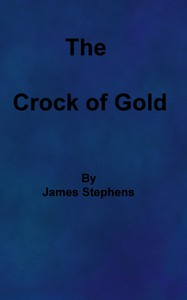
The Crock of Gold — Reading Companion
9
1
Project Gutenberg
1999
Ireland -- Fiction; Fairies -- Fiction; Pan (Greek deity) -- Fiction
Readers of public-domain and historical texts
Project Gutenberg digital edition
en
Edition facts
Words: 60,132
Reading time: 262 min
Text sections: 21
Source:
Project Gutenberg record #1605
James Stephens' 1912 novel blends Irish folklore with philosophical whimsy, following two Philosophers, their wives, and the god Pan through a series of episodic adventures. The narrative shifts between domestic satire, mythic encounters, and lyrical nature writing, structured in six books that mirror a journey out and back.
Editorial Edition Score
4.9/5
★★★★★
★★★★★
Calculated from edition completeness, EPUB availability, text structure and catalogue metadata. Not a user rating.
Edition quality
The Crock of Gold opens with a precise, almost clinical description of two Philosophers living in a pine wood called Coilla Doraca. Their wisdom is second only to the Salmon of Knowledge, and their parchment-like faces and ink-stained nails immediately signal a world where the abstract and the earthy coexist. The narrative voice is wry and compact: the Philosophers answer unanswerable questions, earn the enmity of two women, and are married off as punishment—only to remain oblivious to pinching because their skins are too thick. This deadpan humor, coupled with the matter-of-fact introduction of magical beings, establishes a tone that will recur throughout the book.
A Six-Book Structure of Departure and Return
The novel is divided into six books, each with a distinct focus: The Coming of Pan, The Philosopher’s Journey, The Two Gods, The Philosopher’s Return, The Policemen, and The Thin Woman’s Journey and The Happy March. This architecture suggests a circular pattern—a departure from home, encounters with divine figures, a return, and a final procession. The titles themselves hint at parallel journeys: the Philosopher travels outward, while the Thin Woman later undertakes her own quest. The structure does not follow a single protagonist but shifts perspective, allowing different characters to take center stage in each book. This episodic arrangement, reminiscent of picaresque or folk-tale sequences, gives the narrative a cumulative, mosaic quality rather than a tightly plotted arc.
Recurring Images of Food, Hunger, and Sharing
Food appears repeatedly as a marker of social exchange and hidden meaning. In the excerpt, the Philosopher, hungry after his journey, prepares to eat a cake but instead shares it with a bearded man and his seven children. The man’s courteous reply—“A gift is never little”—is followed by a comic twist: the family produces their own food, and the Philosopher ends up eating with them after all. This scene echoes the earlier domestic friction where the Thin Woman’s anger is expressed through food-related maledictions. The motif recurs in the illustration list: “At that moment the Philosopher’s cake lost all its savour”. These moments use hunger and sharing to probe generosity, obligation, and the gap between philosophical ideals and bodily needs.
Movement Between Domestic and Mythic Spaces
The narrative shifts fluidly from the Philosophers’ household—where wives pinch in bed and children are born on the same day—to the pine wood, to open roads, and to encounters with the god Pan. The opening chapter grounds us in a domestic setting, but the table of contents reveals a journey into myth: Pan arrives, gods debate, and policemen become involved. The excerpt’s description of dawn—“the first level beam stepped like a mild angel to the mountain top”—shows a lyrical attention to natural transition that contrasts with the earlier comic tone. This movement between intimate, often absurd domesticity and expansive, mythic landscapes is a key structural principle, preventing the story from settling into any single register.
Voice and the Play of Wisdom and Foolishness
Stephens’ narrator maintains a detached, ironic stance that undercuts both the Philosophers’ pretensions and the reader’s expectations. The Philosophers are described as wiser than anything except the Salmon, yet they are easily manipulated into marriage and remain unaware of being pinched. The women’s maledictions become a source of further wisdom—a paradox that the narrator presents without comment. This voice extends to dialogue: the bearded man’s elaborate politeness about the shared breakfast is a performance of courtesy that masks a practical joke. The narrative rarely tells us directly whether to admire or laugh at its characters; instead, it layers actions and reactions so that wisdom and foolishness become nearly indistinguishable.
Readers will find that The Crock of Gold rewards attention to its structural seams—the way each book reorients the cast and setting. The recurring images of food, dawn, and journeying are not merely decorative but carry the book’s thematic weight. Approaching it as a series of linked episodes rather than a continuous plot may help in appreciating its shifts in tone and its playful, sometimes elusive, philosophy.
Reader reflection
Record your reading impressions
A brief reflection can help important ideas stay with you longer.
Your progress
0
/
10
2
How did the book work for you overall?
3
Would you encourage someone else to read it?
4
What was the reading difficulty like?
5
Did the book offer a fresh perspective?
6
How strongly did the book affect you emotionally?
7
How well did it match your expectations?
8
Did the story or argument move comfortably?
9
In one sentence, what did you learn?
10