1

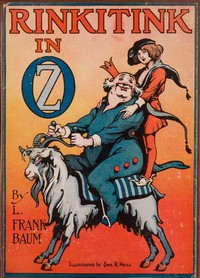
Rinkitink in Oz Wherein Is Recorded the Perilous Quest of Prince Inga of Pingaree and King Rinkitink in the Magical Isles That Lie Beyond the Borderland of Oz — Key Ideas to Explore
10
2
Project Gutenberg
1997
Oz (Imaginary place) -- Juvenile fiction; Fantasy literature; Islands -- Juvenile fiction; Friendship -- Juvenile fiction; Adventure and adventurers -- Juvenile fiction; Goats -- Juvenile fiction; Magic -- Juvenile fiction; Escapes -- Juvenile fiction; Enslaved persons -- Juvenile fiction; Kings and rulers -- Juvenile fiction; Good and evil -- Juvenile fiction; Gale, Dorothy (Fictitious character) -- Juvenile fiction; Wizard of Oz (Fictitious character) -- Juvenile fiction
Readers of public-domain and historical texts
Project Gutenberg digital edition
en
Edition facts
Words: 52,658
Reading time: 229 min
Text sections: 7
Source:
Project Gutenberg record #958
Baum structures this Oz tale around a series of island settings—Pingaree, Regos, Coregos—and a trio of magic pearls that grant strength, protection, and wish-fulfillment. The narrative moves from sea voyages to forest encounters, with recurring images of boats, bridges, and hidden paths.
Editorial Edition Score
4.7/5
★★★★★
★★★★★
Calculated from edition completeness, EPUB availability, text structure and catalogue metadata. Not a user rating.
Edition quality
Baum opens Rinkitink in Oz by anchoring the story in geography: the island of Pingaree is described with precise dimensions—a mile wide at its north end, half a mile at the south, four miles long—and placed in relation to the Nonestic Ocean, the Kingdom of Rinkitink, and the Land of Oz. This careful mapping establishes a world where movement between islands drives the plot. The narrative soon introduces three pearls—pink, blue, and white—each conferring a distinct power: strength, protection, and wish-granting. These objects become the story's structural spine, with their use and loss shaping the characters' journey.
Island Hopping as Narrative Engine
The story progresses through a series of island settings, each with distinct characteristics. Pingaree is the peaceful home of Prince Inga; Regos and Coregos are twin islands ruled by the warlike King Gos and Queen Cor. The journey from Pingaree to Regos and Coregos, then to the Nome King's domain, and finally to the Emerald City, creates a clear geographical progression. Baum reinforces this structure by describing the bridges and boats that connect these places—most notably the bridge of boats that links Regos and Coregos. The movement from one island to another is not merely travel but a shift in tone and stakes, from the domestic opening to the dangers of captivity and the eventual resolution in Oz.
Recurring Images of Strength and Vulnerability
Baum repeatedly contrasts physical strength with helplessness. The pink pearl gives Inga immense power, but he must learn when not to use it. The blue pearl renders him invulnerable, yet he can still be captured through trickery. The white pearl's wish-granting ability is the most potent but is used sparingly. This pattern extends to supporting characters: Zella, the charcoal-burner's daughter, discovers she can lift logs and face wild boars without fear, yet she remains cautious and obedient to her parents. The goat Bilbil, who can speak, is both a comic figure and a voice of blunt truth, often deflating Rinkitink's pretensions. These recurring contrasts—between power and restraint, courage and caution—give the narrative a consistent thematic texture.
The Role of the Forest and the Path
Forests in this story are places of trial and transformation. When Zella cuts through the forest to avoid the warriors, she encounters a tangle of vines that parts at her touch—a moment that reveals her newfound strength. The forest is both obstacle and refuge, and Baum describes it with sensory detail: the thickness of trees, the intertwining vines, the sounds of wild animals. The path itself becomes a motif; characters must choose between the beaten path (which may lead to soldiers) and the untamed forest (which holds beasts but also freedom). This choice recurs in the narrative, emphasizing that safety and danger are not always where they seem.
Voice and Humor in Dialogue
Baum distinguishes characters through their speech patterns. King Rinkitink is garrulous and jolly, often making jokes even in perilous situations. His companion Bilbil the goat is sarcastic and unimpressed, providing a dry counterpoint. Prince Inga speaks with formal politeness, reflecting his royal upbringing. The dialogue is not merely expository; it reveals personality and creates comic relief. For instance, Rinkitink's tendency to chuckle at awkward moments and Bilbil's blunt remarks about his master's weight or cowardice add a layer of humor that lightens the adventure. This interplay of voices gives the story a lively, theatrical quality, as if the characters are performing for an audience.
Readers may find it useful to track the pearls' appearances and the characters' movements between islands, as these elements form the story's backbone. Baum's habit of introducing new settings and characters without extensive backstory means that attention to the physical details—the shape of an island, the nature of a forest, the construction of a bridge—often rewards careful reading. The book's episodic structure, while straightforward, gains coherence from these recurring motifs.
Reader reflection
Your personal reading reflection
Build a private reading journal entry for this title.
Your progress
0
/
10
2
Did this book hold your interest?
3
Is this a title you would suggest to others?
4
Did the language feel accessible?
5
How distinctive were its ideas or approach?
6
Did you gain anything practical from the text?
7
Was the book what you thought it would be?
8
Did any part of the book feel personally relevant?
9
What did this book teach you most?
10