1

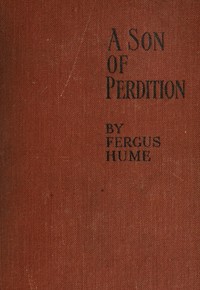
A Son of Perdition: An Occult Romance — A Reader’s Guide
15
2
Project Gutenberg
2012
Magicians -- Fiction; Clairvoyants -- Fiction; Occultism -- Fiction
Readers of public-domain and historical texts
Project Gutenberg digital edition
en
Edition facts
Words: 109,807
Reading time: 478 min
Text sections: 13
Source:
Project Gutenberg record #41071
Fergus Hume's occult romance uses precise diction and dialogue to contrast artistic genius, religious orthodoxy, and esoteric knowledge, with a Cornish setting and recurring symbols like the red granite heart.
Editorial Edition Score
4.8/5
★★★★★
★★★★★
Calculated from edition completeness, EPUB availability, text structure and catalogue metadata. Not a user rating.
Edition quality
Fergus Hume opens A Son of Perdition with a painter, Hardwick, despairing over his inability to capture a Cornish sunset, while the girl at his elbow, Miss Enistor, defines genius as the power to make others see as vividly as oneself. This early exchange establishes a central tension between talent and vision, and between the visible world and hidden meanings. The novel’s dialogue is often philosophical, with characters debating art, faith, and the occult in a manner that reveals their distinct voices: Hardwick’s laborious reflection, Montrose’s confident esotericism, and the vicar’s wife’s resentful piety. The Cornish landscape—grim, opalescent, and ancient—serves as more than backdrop; it is a stage for conflicts between materialism and mysticism.
Diction and the Language of Belief
Hume’s word choices mark characters by their intellectual and spiritual leanings. The vicar’s wife, Mrs. Sparrow, thinks in terms of “heathen” and “the wicked,” contrasting with Montrose’s vocabulary of “Atlantean race,” “sacred word,” and “hieroglyphics.” The Squire, Enistor, is pragmatic, using archaeology to sidestep theology. The narrator’s own diction shifts: when describing Mrs. Sparrow’s resentment, the prose becomes ironically precise—“she frequently doubted if the world was governed justly”—while the occult discussions employ terms like “trance,” “star-worship,” and “red granite heart.” This lexical variety creates a layered world where each character speaks a slightly different language of belief.
Dialogue as Debate
Conversations in the excerpts are structured as debates, not mere exchanges. Hardwick and Miss Enistor argue about genius; Montrose and Sparrow clash over Atlantis versus Druids. Hume uses dialogue to advance plot and theme simultaneously. For instance, Montrose’s insistence that “Atlantis did exist” is countered by Sparrow’s “Absurd!”—a clash that echoes the novel’s larger conflict between occult and orthodox worldviews. The dialogue is often didactic, with characters lecturing one another, yet it remains natural to their roles: the artist questions, the occultist explains, the clergyman dismisses. This technique keeps exposition lively while revealing each speaker’s intellectual territory.
Description and the Seen World
Hume’s descriptive passages are economical but evocative. The sunset is “opalescent,” the table “snow-white” with “scarlet and golden autumn leaves.” These details ground the occult elements in a tangible reality. The Cornish setting is described with a geologist’s eye: “grim Cornish country,” “far-stretching Atlantic waters,” a hill with a Roman camp. The red granite heart is a physical object, dug from the earth, that triggers metaphysical debate. By anchoring the supernatural in precise, sensory description—crystal, silver, wax candles—Hume makes the fantastic feel credible. The contrast between the vicarage’s “unlovely surroundings” and the Squire’s luxury further emphasizes a world of material disparities.
Recurring Details and Structural Echoes
Certain motifs recur across the excerpts. The “heart” appears as a symbol—first as a carved artifact, then as a topic of theological dispute. The word “genius” is debated early and later implied in the contrast between talent and occult knowledge. The setting of the hill, with its Druidical altar and Roman camp, is mentioned twice, linking past and present. These repetitions are not accidental; they create a web of meaning that rewards close reading. Hume also uses structural parallels: the opening sunset scene, with its painterly frustration, mirrors later scenes where characters attempt to interpret hidden signs. The reader is invited to see connections between the visible and the invisible, much like the artist who struggles to “transfer that to canvas.”
Readers attentive to Hume’s authorial choices will notice how diction, dialogue, and description work together to build a world where the occult is treated seriously, not sensationally. The novel rewards those who track recurring symbols and debates, as these elements foreshadow later developments. Approach the text as a puzzle of voices and visions, where every character’s language reveals their allegiance in the eternal strife between faith and knowledge.
Reader reflection
Record your reading impressions
A brief reflection can help important ideas stay with you longer.
Your progress
0
/
10
2
How much did you enjoy the reading experience?
3
Would you pass this book on to a friend?
4
How easy was the book to follow?
5
What was the strongest part of the book?
6
How did the pace of the book feel?
7
Did you relate to its people, ideas, or situations?
8
How useful were the ideas in this book?
9
What changed or sharpened your thinking?
10