1

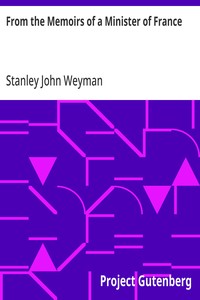
From the Memoirs of a Minister of France — Context and Discussion
10
3
Project Gutenberg
2000
Biographical fiction; Henry IV, King of France, 1553-1610 -- Fiction; France -- Kings and rulers -- Fiction
Readers of public-domain and historical texts
Project Gutenberg digital edition
en
Edition facts
Words: 76,342
Reading time: 332 min
Text sections: 7
Source:
Project Gutenberg record #2079
This editorial note examines Stanley Weyman's episodic novel through its structure of framed memoirs, recurring images of ruined landscapes and one-eyed warnings, and the movement between courtly intrigue and provincial danger.
Editorial Edition Score
4.7/5
★★★★★
★★★★★
Calculated from edition completeness, EPUB availability, text structure and catalogue metadata. Not a user rating.
Edition quality
Stanley Weyman's From the Memoirs of a Minister of France presents itself as a series of recollections by the Duc de Sully (Maximilien de Béthune), chief minister to Henry IV. The narrator opens by defending his selectivity, claiming he omits flattering episodes and will instead relate one where he 'showed to less advantage than usual.' This framing device establishes a voice that is self-aware, slightly defensive, and attuned to the political calculations behind every anecdote. The work is structured as twelve discrete chapters, each a self-contained episode, yet linked by the minister's perspective and the recurring tension between courtly maneuvering and the disorder of the provinces.
A Framed Narrative of Self-Justification
The opening paragraphs function as a meta-commentary on the memoir form itself. The narrator anticipates accusations of vanity and counters by promising to include a story that reflects poorly on him. This rhetorical strategy—protesting too much—colors every subsequent tale. The reader is never allowed to forget that the account is filtered through a narrator with a reputation to manage. Weyman uses this frame to create distance: we see events through Sully's eyes, but also hear him justifying his choices to an imagined critic. The effect is a layered reading experience where the minister's reliability is always in question.
Ruins, Fords, and the One-Eyed Warning
In the excerpt from the chapter 'The Governor of Gueret,' the landscape itself becomes a character. The valley of the Creuse is described with 'ruins, blocked defiles, and overgrown roads,' a stark contrast to the King's peace that Sully expects to see. The journey is punctuated by a mysterious astrologer who delivers a cryptic warning: 'A one-eyed woman and a one-eyed house.' This image recurs when the party arrives at an inn and encounters a one-eyed woman carrying sticks. The coincidence is explained away rationally, but the atmosphere of decay and threat lingers. Weyman uses physical details—a prostrate gate, a scorched inn, a thunderstorm—to embody the disorder that Sully's political work is meant to overcome.
Movement Between Court and Province
The narrative structure depends on Sully's movements: from St. Germains to Poissy, from Paris to the Creuse valley. Each shift in setting brings a corresponding shift in tone. At court, the conflicts are verbal and political—quarrels over christening expenses, negotiations with beggars like M. de Perrot. In the provinces, danger is physical and immediate: ruined villages, suspicious innkeepers, and the threat of robbers. The minister's authority, so assured in the corridors of power, becomes fragile when he is isolated. This oscillation between the controlled space of the court and the unpredictable countryside gives the episodic chapters a dynamic rhythm, each journey a potential descent into chaos.
Recurring Motifs of Surveillance and Secrecy
Throughout the excerpts, characters are watched and watch. The narrator notes that M. de Perrot is 'in all our secrets,' and the astrologer seems to know Sully's identity despite his plain dress. The one-eyed woman at the inn suggests a world where vision is impaired yet insight persists. Weyman's prose is filled with glances, eavesdropping, and sudden revelations. The minister's memoirs themselves are an act of surveillance, preserving what might otherwise be lost. This motif of seeing and being seen reinforces the political theme: in a court built on favor and intrigue, nothing is truly hidden, and every gesture may be recorded for posterity.
Readers approaching From the Memoirs of a Minister of France should attend to the gaps between what Sully says and what the scenes imply. The episodic structure rewards attention to recurring images—ruined buildings, one-eyed figures, fords—that accumulate meaning across chapters. Weyman's historical fiction works less by plot than by atmosphere and the minister's distinctive, self-justifying voice. Treat each chapter as a discrete anecdote while watching for the threads that bind them: the tension between order and decay, and the narrator's constant effort to shape his own legacy.
Reader reflection
Record your reading impressions
A brief reflection can help important ideas stay with you longer.
Your progress
0
/
10
2
How much did you enjoy the reading experience?
3
Would you recommend this book to another reader?
4
How demanding did the text feel?
5
How useful did the reading feel?
6
How closely did the book connect with your experience?
7
Did the book deliver what you hoped for?
8
Could you see yourself revisiting this book?
9
In one sentence, what did you learn?
10