1

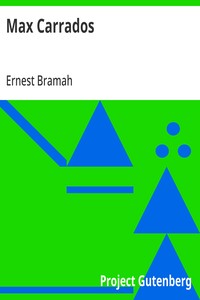
Max Carrados — Story, Setting & Ideas
13
0
Project Gutenberg
2010
Detective and mystery stories, English; Private investigators -- Fiction; Blind -- Fiction
Readers of public-domain and historical texts
Project Gutenberg digital edition
en
Edition facts
Words: 72,569
Reading time: 316 min
Text sections: 8
Source:
Project Gutenberg record #34732
Ernest Bramah's 1914 collection introduces blind detective Max Carrados, who solves cases through acute hearing, touch, and logic. The stories balance precise deduction with vivid scenes of Edwardian life, from coin shops to Australian mining claims.
Editorial Edition Score
4.7/5
★★★★★
★★★★★
Calculated from edition completeness, EPUB availability, text structure and catalogue metadata. Not a user rating.
Edition quality
Ernest Bramah's Max Carrados (1914) opens not with its blind detective but with a coin dealer reading the Pall Mall on a rainy night. The first story, 'The Coin of Dionysius,' establishes a pattern: a client arrives with a problem—here, a possibly forged tetradrachm—and Carrados enters only after the stage is set. Bramah uses physical details—the drip of an umbrella, the careful touch of a coin—to ground his mysteries in tangible reality. Carrados's blindness becomes an asset, not a limitation; he reads voices, footsteps, and the texture of objects. The collection moves between London offices, country houses, and even a Western Australian gold claim, each setting rendered with specific, unshowy observation.
The Detective's Method: Listening and Touch
Carrados's blindness is not a gimmick but the foundation of his investigative method. In 'The Coin of Dionysius,' he identifies a man's sleepless night by the sound of his voice: 'I don't think that you slept much last night.' The client, Draycott, confirms he did not sleep at all. Carrados laughs and says, 'Oh yes. But never mind that.' Bramah avoids melodrama; the detective's abilities are presented as matter-of-fact. He reads the weight and edge of a coin, the tension in a room, the hesitation in a phrase. His sidekick, the inquiry agent Carlyle, provides a conventional foil, but Carrados consistently outpaces him through patient attention to what others overlook.
Movement Between Worlds: London and Beyond
The stories shift rapidly between social and geographical settings. 'The Coin of Dionysius' begins in a modest coin shop, then moves to Carrados's comfortable home. 'The Knight's Cross Signal Problem' involves a railway signalman and a country station. 'The Tragedy at Brookbend Cottage' takes place in a suburban house. But the most striking shift comes in 'The Last Exploit of Harry the Actor,' which includes a long flashback to a Western Australian gold claim. Draycott, the engineer, describes his work with 'steady, half-closed eyes, with the suggestion of depth which one notices in the eyes of those whose business it is to look out over great expanses of land or water.' Bramah uses these contrasts—between city and outback, drawing room and mine—to keep the reader off balance.
Recurring Images: Coins, Gold, and Paper
Physical objects carry the weight of the plots. Coins appear repeatedly: the tetradrachm of Dionysius, a rare Saxon penny, a doubtful noble. Gold is central to 'The Last Exploit of Harry the Actor,' with its 'Magdalena Lodestar' nugget and samples of quartz. Paper is equally important: a sheet of wrapper paper left in an empty safe, a label from a cabinet, a letter of credit. Bramah describes these items with precision—the weight of a nugget 'just under seven pounds of pure gold,' the feel of a coin 'held by the edge with the careful touch of an expert.' These details are not decorative; they are the clues Carrados reads with his hands and ears.
Structure: The Delayed Entrance of the Hero
Bramah often withholds Carrados until the story is well underway. In 'The Coin of Dionysius,' the first several pages follow Carlyle and the coin dealer Baxter; Carrados is mentioned but does not appear until the scene is set. In 'The Last Exploit of Harry the Actor,' Draycott narrates his entire backstory before Carrados speaks. This structure gives the reader time to appreciate the problem before the solution arrives. It also means that Carrados's interventions feel earned, not arbitrary. The stories are not puzzles with a sudden reveal; they are investigations in which the detective's method is as important as the outcome.
Readers who enjoy Edwardian detective fiction will find Max Carrados a distinctive addition to the genre. Bramah's focus on sensory detail and his willingness to let his hero remain offstage for long stretches set these stories apart from more formulaic contemporaries. The collection rewards attention to small things: the sound of a voice, the weight of a coin, the texture of a piece of paper.
Reader reflection
What was your reading experience?
Capture what you thought, learned, and would like to remember.
Your progress
0
/
10
2
How did the book work for you overall?
3
Would you encourage someone else to read it?
4
Did the language feel accessible?
5
How distinctive were its ideas or approach?
6
How valuable was this book for your own interests?
7
Is this a title worth rereading?
8
Which aspect of the book did you value most?
9
In one sentence, what did you learn?
10