1

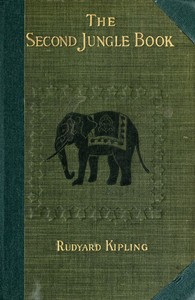
The Second Jungle Book — Inside the Classic
12
1
Project Gutenberg
2011
India -- Fiction; Jungle animals -- Fiction; Mowgli (Fictitious character) -- Fiction
Readers of public-domain and historical texts
Project Gutenberg digital edition
en
Edition facts
Words: 68,679
Reading time: 299 min
Text sections: 9
Source:
Project Gutenberg record #37364
Kipling's sequel expands the Jungle Law through Mowgli's encounters with treasure, drought, and the White Cobra, while introducing non-Mowgli tales like 'The Miracle of Purun Bhagat' and 'Quiquern.' The narrative voice shifts between fable-like cadence and precise natural observation.
Editorial Edition Score
4.7/5
★★★★★
★★★★★
Calculated from edition completeness, EPUB availability, text structure and catalogue metadata. Not a user rating.
Edition quality
The Second Jungle Book opens not with Mowgli but with a poem that sets a scene of drought: 'The stream is shrunk—the pool is dry.' This prelude immediately establishes a tone of scarcity and truce, framing the Law of the Jungle as something tested by environmental pressure. The first story, 'How Fear Came,' picks up this thread, with Baloo warning that the Law 'drops across every one's back and no one can escape.' Kipling's narrative voice here is measured, almost proverbial, yet it shifts into vivid, sensory detail when describing the treasure vault in 'The King's Ankus'—a passage dense with enumerated jewels, metals, and artifacts. The contrast between abstract law and concrete, glittering objects is a structural pattern throughout the collection.
The Law as a Narrative Engine
Kipling uses the Law of the Jungle not merely as a code but as a device that generates conflict and resolution. In 'How Fear Came,' the drought forces a Water Truce, and the story of how the first tiger got his stripes is told as an origin myth embedded within the frame. The Law is personified as 'the Giant Creeper' that no one can escape, a metaphor that recurs in Mowgli's negotiations with the White Cobra. The cobra's insistence on its 'wardship' of the treasure mirrors the Law's rigidity, while Mowgli's pragmatic responses—'I see nothing here to take away'—highlight the gap between ancient rule and immediate need. This tension between fixed law and adaptive survival drives the pacing, alternating between slow, ceremonial exposition and sudden, decisive action.
Voice and Cadence in the Non-Mowgli Tales
The collection includes stories outside Mowgli's arc, such as 'The Miracle of Purun Bhagat' and 'Quiquern,' which shift the narrative voice from the jungle's communal 'we' to a more detached, almost ethnographic register. 'Purun Bhagat' follows a former prime minister who becomes a holy man, and the prose adopts a measured, reverent tone, with short declarative sentences: 'He was a holy man.' In contrast, 'Quiquern,' set in the Arctic, uses a clipped, urgent rhythm suited to sled-dog survival. The poem 'Angutivun tina' that follows it reinforces the shift in geography and pace. These variations prevent the book from becoming monotonous, though they also fragment the reading experience—each tale demands a different attention to rhythm and setting.
Pacing Through Accumulation and Interruption
Kipling controls pace by alternating dense descriptive passages with abrupt dialogue or action. The treasure vault in 'The King's Ankus' is a prime example: a single sentence enumerates 'jeweled elephant-howdahs,' 'palanquins and litters,' 'golden candlesticks,' and more, creating a cumulative effect that slows time. Then Mowgli's cool reply—'I see nothing here to take away'—cuts through the buildup. Similarly, in 'Red Dog,' the narrative builds tension through the wolves' council and Mowgli's planning, then releases it in swift, brutal combat. The poems interspersed between stories act as interludes, resetting the emotional register. This structural rhythm means the book rewards readers who attend to its shifts in tempo rather than expecting a uniform narrative flow.
Readers coming from The Jungle Book will find a more varied collection here, one that tests the Law across different landscapes and species. Pay attention to the poems—they often distill the mood of the preceding story. The White Cobra's treasure scene, with its relentless inventory, is worth rereading for how Kipling makes abundance feel oppressive. The book's strength lies not in plot but in the texture of its language and the deliberate changes in narrative speed.
Reader reflection
Take a moment to reflect on this book
Create a short personal record of your experience with this book.
Your progress
0
/
10
2
Did this book hold your interest?
3
Is this a title you would suggest to others?
4
How easy was the book to follow?
5
Would you start a conversation about this book?
6
How did the reading compare with what you expected?
7
Could you see yourself revisiting this book?
8
How understandable was the text?
9
In one sentence, what did you learn?
10